
How Many Solar Street Lights Do I Need? Worked Examples
Shinesun's editorial team writes about solar lighting based on our manufacturing, installation, and field-service experience across India.
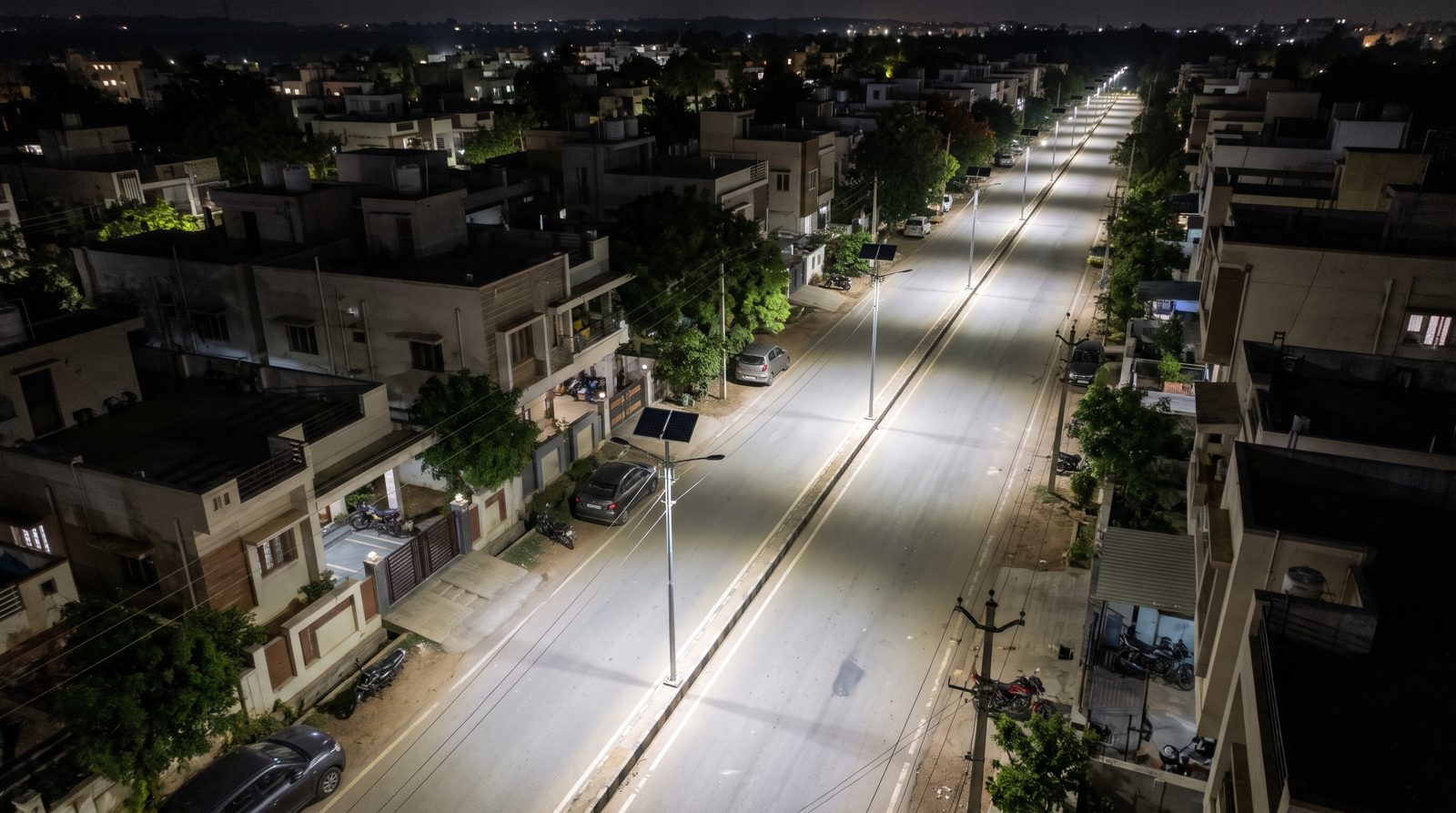
How many solar street lights do I need? Divide the length you want lit by the pole spacing, round up, and add one pole for the far end. With fixtures on 5 m poles, spacing is 12 to 15 m, so a 30 m driveway takes three poles and a 150 m road takes about 11 to 14.
This guide shows the arithmetic for the sites we are asked about most: driveways, roads, wider roads, compound perimeters and residential layouts. Choosing the fixture itself is covered in how many watts you need.
The rule behind every count
Solar street light pole spacing runs at about three times the mounting height. At our standard 5 m mounting height that gives 12 to 15 m between poles, and the Bat 150W at 6 to 7 m holds 15 m. Spacing is set by height, not by wattage.
The count then follows in three steps. Each one is plain arithmetic.
- Measure the length of the road, drive or boundary to be lit.
- Divide by the spacing and round up to a whole number of gaps. Rounding down is how dark patches get built in.
- Add one pole for a line with a light at each end. A closed loop, such as a perimeter, needs no extra pole, because the last gap ends at the first pole.
Worked examples
A 30 m driveway
30 m divided by 15 m is 2 gaps, plus one pole, which makes 3 poles. Put one near the gate, one midway and one at the house end. A short drive of 10 to 12 m is usually covered by a single pole near the middle.
A 150 m road, one side
At 15 m spacing, 150 m is 10 gaps, so 11 poles. At 12 m spacing, 150 m is 12.5 gaps, which rounds up to 13, so 14 poles. On a narrow road or farm approach, one row along one side is enough.
Wider roads: one side, staggered or both sides
One row works while the road is about as wide as the pole is tall. Beyond that, the far edge starts to fall into shadow, and the lights need to go on both sides.
- Staggered. Lights alternate sides, still about 15 m apart along the road. The 150 m road takes about 11 fixtures, the same as one side, but light reaches both edges more evenly.
- Both sides, opposite. Poles face each other in pairs at 15 m. The 150 m road then takes 11 on each side, 22 in all. This suits wide roads and entrances where both edges carry traffic or people.
A compound perimeter
Take a rectangular compound of 60 m by 40 m, with a pole at each corner. Each long side is 60 divided by 15, or 4 gaps. Each short side is 40 divided by 15, about 2.7, which rounds up to 3 gaps of about 13.3 m.
That gives 4 + 3 + 4 + 3 = 14 gaps around the loop, so 14 poles. As a check, the perimeter is 200 m, and 200 divided by 15 is about 13.3, which rounds up to the same 14.
A residential layout
Count each road on its own, then remove the doubles. A layout with four internal roads of 100 m each needs 100 divided by 15, about 6.7, rounded up to 7 gaps, so 8 poles per road. That is 32 before you share the poles that land on the same junction.
Gates, parks and footpaths inside the layout are planned separately. Light levels for each zone are covered in planning lighting for gated societies.
How many solar street lights do I need: the examples in one table
| Site | Length | Spacing | Arrangement | Poles (about) |
|---|---|---|---|---|
| Short driveway | 10–12 m | – | One pole midway. | 1 |
| Home driveway | 30 m | 15 m | One side. | 3 |
| Approach road | 150 m | 15 m | One side. | 11 |
| Approach road | 150 m | 12 m | One side. | 14 |
| Wider road | 150 m | 15 m along the road | Staggered. | 11 |
| Wide road | 150 m | 15 m | Both sides, opposite. | 22 |
| Compound, 60 x 40 m | 200 m loop | 13–15 m | Perimeter. | 14 |
| Layout, four 100 m roads | 400 m | About 14 m | One side. | 32, less shared junctions |
Why stretching the spacing does not save money
It is tempting to space poles at 20 or 25 m to buy fewer lights. On a 5 m pole that leaves the ground between pools of light much darker than the ground under each pole. The eye adjusts to the bright patches, so the gaps look darker still.
People notice the dark stretches more than the bright ones, and a road that is bright, dark, bright feels less safe than one that is evenly lit. Uniform light at the right spacing does more than the same number of watts spread over fewer poles.
Raising the pole to stretch the spacing does not solve it either. A higher mount spreads the same light thinner over more ground. Our note on street light pole height explains why we standardise on 5 m.
When to step up wattage instead of adding poles
Adding poles fixes length. Stepping up the fixture fixes the amount of light on the ground, and that is the answer when the use needs more than a residential lane does.
- Home driveways and lanes. The Bat 40W gives 1,600 lumens from a 5 m pole at 12 to 15 m spacing.
- Parking, larger compounds and main roads in a layout. The Bat 75W at 2,760 lumens or the Bat 90W at 3,129 lumens puts more light on the same spacing.
- Wide roads and industrial yards. The Bat 150W gives 6,000 lumens from a 6 to 7 m pole at 15 m spacing, for double-lane roads and large open ground.
- Gates and back yards. The Owl 100W idles dim and rises to full on movement, which suits a spot that needs light only when someone is there.
A mix is normal. A farmhouse might run Bat 40W fixtures along the drive, a Bat 90W over the parking area and an Owl at the back gate. For a home site, see choosing a solar street light for home.
What to send us for a count
Send the length of each road or boundary, its width, any existing poles and what the ground is used for. A rough sketch with distances is enough. We will work out the pole count and fixtures against these numbers and quote the lights, poles and installation.
Frequently asked questions
How far apart should solar street lights be?
About three times the mounting height. At 5 m that is 12 to 15 m between poles; the 150 W at 6 to 7 m holds 15 m. Wider spacing leaves dark gaps between the pools of light.
How many solar street lights for a 100 m road?
About 8 on one side. 100 m divided by 15 m is about 6.7, rounded up to 7 gaps, plus one pole for the far end. A wide road lit from both sides, opposite, takes about 16.
How many lights does a 30 m driveway need?
Three: one near the gate, one midway and one at the house end, 15 m apart on 5 m poles. A drive of 10 to 12 m is usually covered by one pole near the middle.
Should I light one side of the road or both?
One side while the road is about as wide as the pole is tall. Wider roads need lights on both sides, either staggered or in opposite pairs, so the far edge does not fall into shadow.
Can I use fewer, brighter lights instead of more poles?
Not along the length. Spacing is set by mounting height, so a brighter fixture on a stretched spacing still leaves dark gaps. Step up wattage when the ground needs more light, not to remove poles.
Talk to the people who build them
Shinesun manufactures solar street, flood, garden, pathway and gate lighting in Bangalore and supplies across India. Everything is quoted against the site rather than sold from a cart, because the right fixture depends on where it is mounted and what the ground is used for. Browse the street light range or tell us about the site.
Shinesun Solar Street Lights
See the full range ›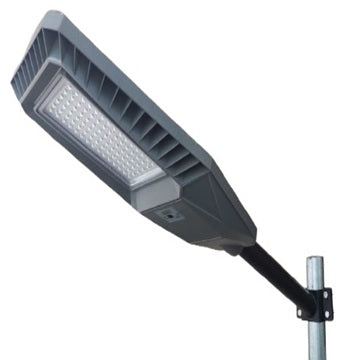
Related reading
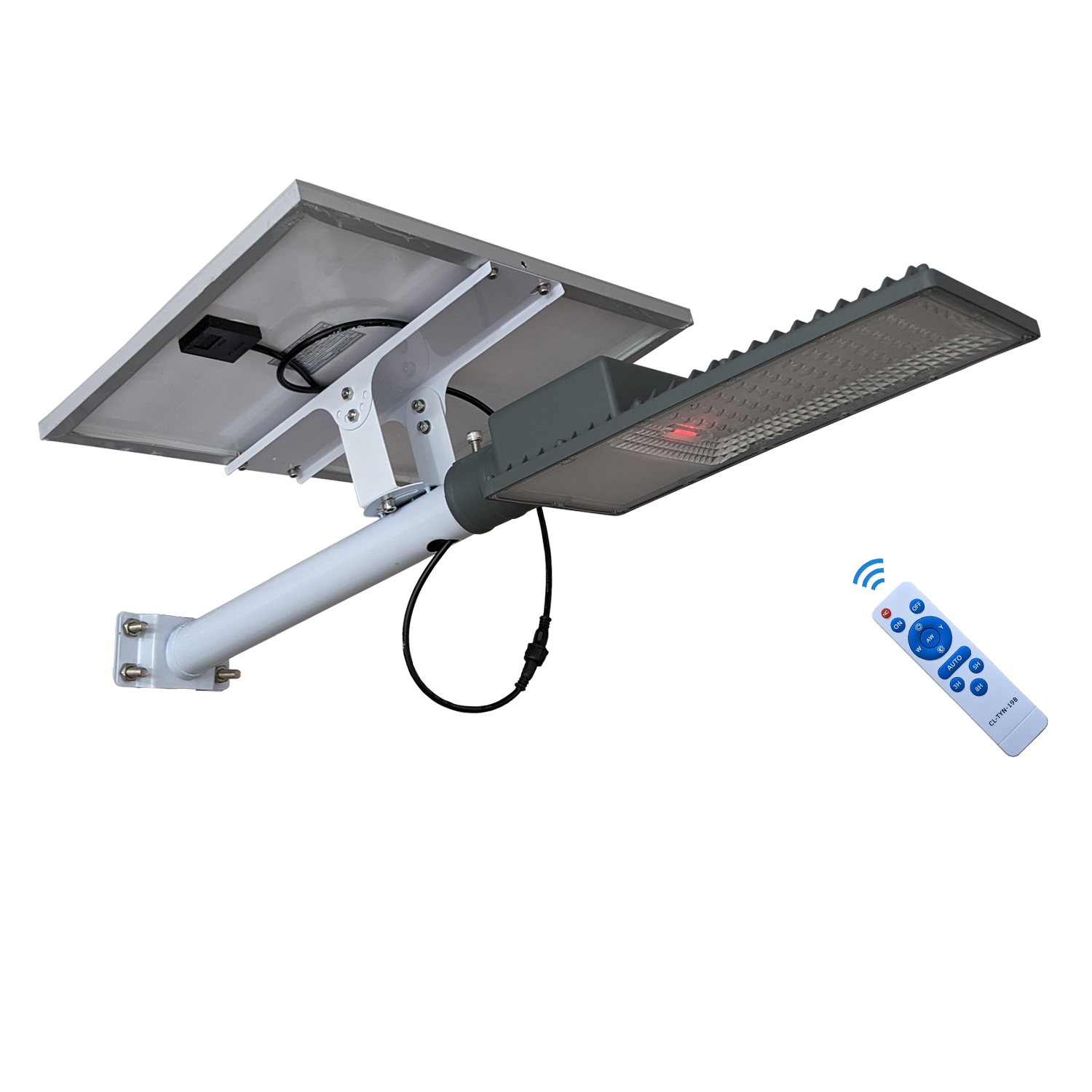
How Many Watts of Solar Street Light Do You Need?
Wattage is the number everyone quotes and the worst one to start from. Mounting height and spacing decide the answer, and getting those wrong is behin...
Read more
Solar Street Light for Home: Sizing, Price and Setup
A 40 W solar street light on a 5 m pole lights most home driveways and compounds with no wiring and no bill. How to size one, what it costs and how to...
Read more
LiFePO4 vs Lithium-Ion in Solar Street Lights: Which and Why
LiFePO4 and lithium-ion get used as if one were simply the better version of the other. They are different chemistries with different jobs, and the ri...
Read more