
Solar Street Lights
Pole-mounted solar street lights manufactured in Bangalore — 40 W to 150 W on LiFePO4 batteries, with MPPT controllers above 30 W and IP66 die-cast aluminium housings, rated for 8 to 12 years of service. Compare fixtures below, or scroll past them for mounting height, pole spacing and the full 2026 buyer's guide.
 20% off
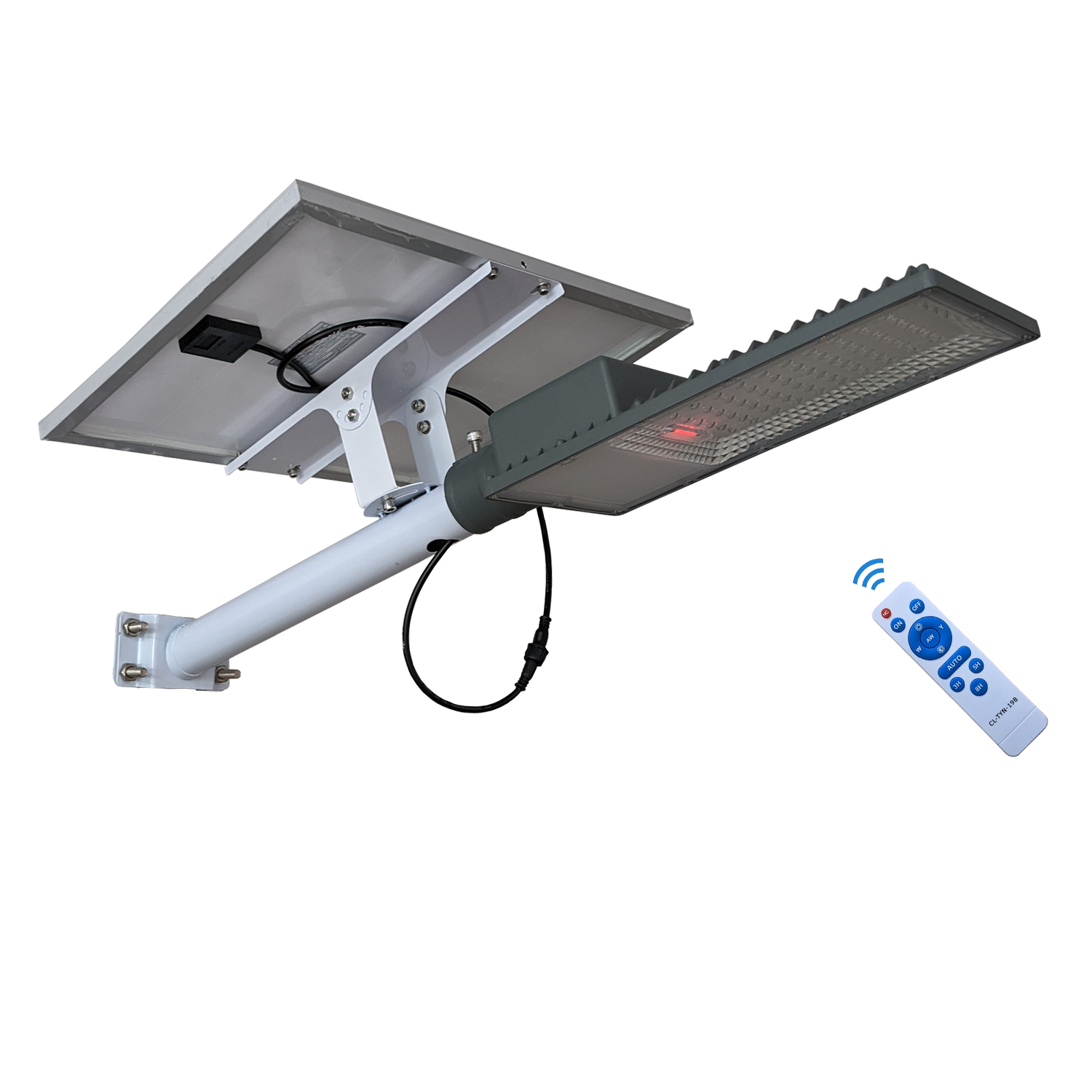
Solar Bat Street Light 75 Watt - TTBAT75W
Save ₹2,249
 20% off
Solar Bat Street Light 40 Watt - TTBAT40W
Save ₹1,801
 20% off
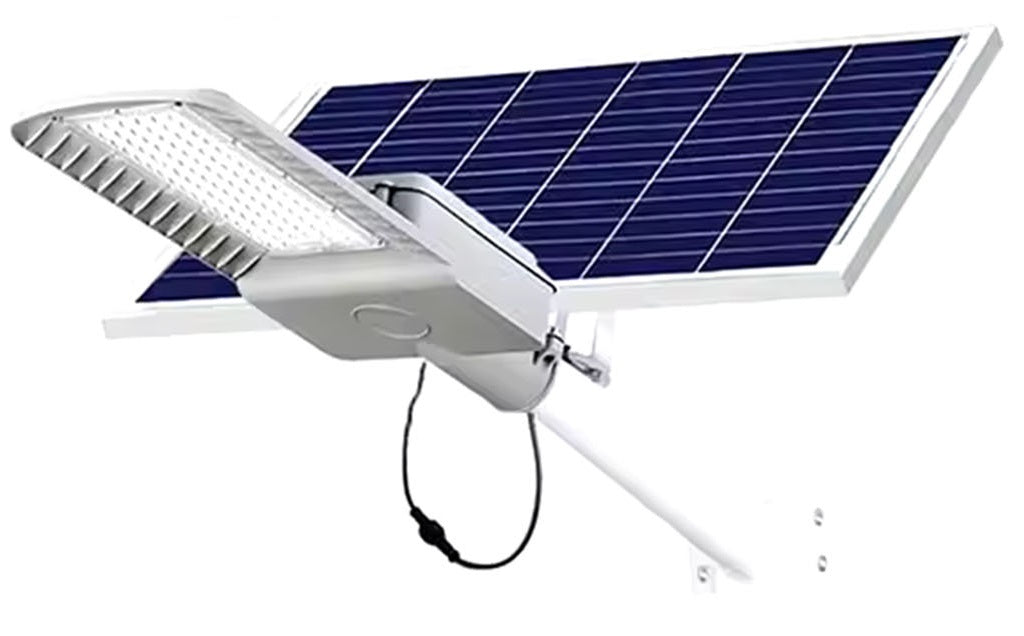
Solar Bat Street Light 150 Watt - TTBAT150W
Save ₹3,700
 23% off
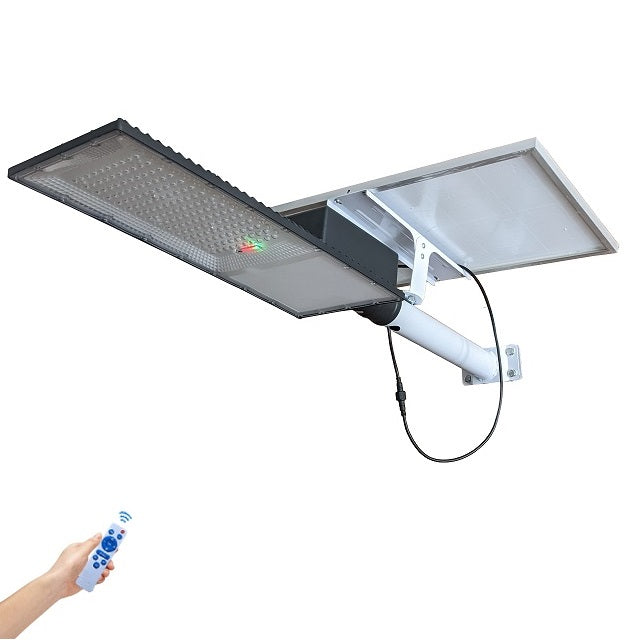
Solar Bat Street Light 90 Watt - TTBAT90W
Save ₹3,499
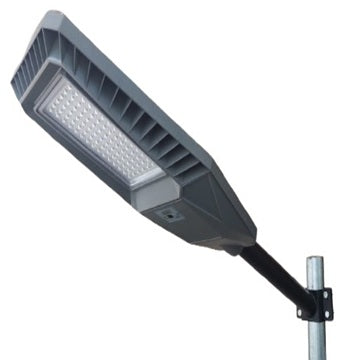 40% off
Solar Owl Street Light 100 Watt - TTOWL100W
Save ₹3,000
About Solar Street Lights
Shinesun manufactures and supplies solar street lights across India for residential compounds, commercial streets, industrial yards, society roads, parking areas, and public lighting projects. The range covers 40W to 150W in two main categories — all-in-one fixtures with panel, battery, controller, and LED in a single housing, and integrated street lights where the panel and fixture are factory-matched but mount separately.
Each fixture in this collection is built around a LiFePO4 battery (8 to 12 year expected service life), a monocrystalline solar panel sized at 2-3× the LED wattage, an MPPT charge controller on fixtures above 30W, and an IP66 die-cast aluminium housing — the four specs that separate fixtures that last from fixtures that fade within a season. See our 2026 buying checklist for the full evaluation framework.
How to choose the right solar street light
Picking a solar street light is mostly about matching the fixture to where it will be installed. Get any one of pole height, area, sun exposure, or autonomy days wrong and the light either over-lights some zones, under-lights others, or runs out of battery on the second cloudy day.
Wattage by mounting height and application
| Mounting height | Fixture | Pole spacing | Best for |
|---|---|---|---|
| 5 m | 40 W | 12–15 m | Residential lanes, society internal roads, driveways |
| 5 m | 75–90 W | 15 m | Arterial roads inside a layout, larger compounds, parking areas |
| 5 m | 100 W | as required | Main gates and security points, where faces and number plates must be readable |
| 6–7 m | 150 W | 15 m | Wide or double-lane roads, industrial yards, large open areas |
Pole spacing runs at about three times the mounting height, pole to pole, capped at around 15 m. At a 5 m mounting height that is 12 to 15 m. This is deliberately tighter than the 3–4× ratio quoted for grid lighting: that figure assumes mains fixtures producing several times more light per watt, and at 4× a 40 W solar fixture falls below the roughly 5 lux minimum a residential road needs, leaving dark ground between the pools of light. Mounting higher does not rescue it — the same output spread over more ground lowers the lux everywhere. See pole height sizing, pole spacing and lux levels and how to choose the right fixture.
What's inside a quality 2026 solar street light
LiFePO4 battery (non-negotiable)
For any solar street light meant to last, lithium iron phosphate (LiFePO4) is the only battery chemistry that fits in 2026. It tolerates the 40-50°C heat that Indian summers put on a pole-mounted fixture, has very low fire risk under failure conditions, and typically delivers 3,000-4,500 cycles — roughly 8 to 12 years of practical service on the original pack. Lead-acid means 2-3 year replacement cycles; generic "lithium" without specified chemistry is a red flag. Every fixture in this collection ships with disclosed LiFePO4 cells.
Monocrystalline solar panel
Monocrystalline panels deliver 20-23% efficiency in commercial production — better than polycrystalline (15-18%) in both peak output and low-light performance. The 2026 price gap is small enough that there's little reason to specify poly new. See mono vs poly comparison for the full breakdown. The panel-to-LED wattage ratio should be at least 2-3× — a 40W LED needs an 80-120W panel — to keep the battery topped up through monsoon and dust accumulation.
MPPT charge controller (above 30W)
The charge controller manages how power flows from panel to battery and from battery to LED. PWM controllers (older, simpler) work fine on fixtures under 30W where the few-percent efficiency loss is small. MPPT controllers (Maximum Power Point Tracking) extract 20-30% more energy in cloudy and marginal conditions — for any fixture above 30W in Indian monsoon-affected regions, MPPT is the right call. See PWM vs MPPT in detail.
LED chip and lumen output
Modern LED chips deliver 130-160 lumens per watt at system level. Branded chips (Bridgelux, Lumileds, Osram) consistently outperform no-name chips on both initial output and lifetime degradation. Always check rated lumens, not just wattage — two fixtures sold as "40W" can deliver a 50% brightness gap. See LED wattage explained and lumens in LED solar lights.
IP66 die-cast aluminium housing
For Indian monsoon and coastal conditions, IP66 is the right specification — dust-tight and protected against heavy rain and pressure spray. IP65 works in sheltered or mild-monsoon zones; below IP65 is for indoor or under-eave use only. Housing material matters too — die-cast aluminium with powder coating outlasts ABS plastic by years in Indian sun. See IP ratings explained.
Motion sensor (standard in 2026)
A motion sensor (PIR or microwave radar) dims the LED to ~30% when nothing's around and ramps to full output on detection. The net effect is roughly double the useful battery hours, plus better perceived security for residential and commercial applications. See PIR sensors explained.
Solar street light price ranges in India (2026)
Indicative 2026 prices for quality solar street lights from Indian manufacturers using LiFePO4 batteries, monocrystalline panels, and branded LED chips:
- 30-50W (residential lanes, driveways, society internal roads) — ₹6,000-15,000
- 60-100W (arterial roads inside a layout, larger compounds, parking, main gates) — ₹12,000-25,000
- 120-200W+ (wide or double-lane roads, industrial yards, large open areas) — ₹20,000-40,000+
Our own range starts at 40 W; the sub-30 W fixtures were withdrawn in 2026. For mounting height and pole spacing use the table above rather than the pole heights usually quoted alongside these price bands — those assume grid fixtures producing several times more light per watt, and applying them to a solar fixture leaves dark ground between the poles.
Cheap imports can come in lower — typically with compromised battery chemistry, undersized panels, or no real warranty support. See the full breakdown in our 2026 price guide.
Installation overview
Solar street lights install dramatically simpler than grid-tied fixtures — no trenching, no DISCOM coordination, no meter changes. For pole-mounted street lights:
- Site survey — verify sun exposure at 10am, noon, and 3pm; check for future shading from trees or planned construction
- Foundation — typically 0.6×0.6×0.8m of M25 concrete with anchor bolts for 4-6m poles; deeper for taller poles; 14-day cure before pole loading
- Pole installation — galvanised steel (hot-dip preferred) with verified verticality and torque-tightened anchor bolts
- Fixture mounting — bracket aimed for required lit-area coverage
- Earthing — copper rod or plate driven into ground at pole base, connected to surge protection inside the fixture
- Commissioning — dusk operation, motion sensor behaviour, and LED output verified per fixture
For commercial scale (typically 20+ fixtures), see our technical guideline for solar street light projects and the practical installation guide.
Standards and compliance
What to specify and verify when procuring solar street lights in 2026:
- BIS (Bureau of Indian Standards) — for solar PV modules and LED end products
- IEC standards — IEC 61215 / 61730 (panels), IEC 62717 / 62722 (LED), IEC 60598 (luminaires)
- IP rating certification — IP66 verified by independent test report
- SPD (surge protection device) — Class II or III, integrated
- ALMM listing (MNRE Approved List of Models and Manufacturers) — List-I for modules, List-II for cells. List-II becomes mandatory from 1 June 2026 for government, PSU, and CPSU procurement, alongside the long-standing List-I requirement
- ISO 9001 — quality management system at the manufacturing site
For government and institutional projects, ALMM compliance is not optional from June 2026. For private commercial and residential buyers, ALMM is a useful quality filter even when not required. See more on evaluating solar street light manufacturers.
Does the price include the pole?
No, and it is worth saying plainly because it is the most common source of surprise in a solar street light quotation.
Listed prices are for the fixture. Poles vary by height, material, wall thickness and foundation requirement, they are heavy to ship, and they are usually sourced locally to the site for that reason. A 5 m galvanised pole with a foundation typically adds a substantial fraction of the fixture cost, and on a project it is often the larger line.
When comparing quotations, confirm what each one includes. A price that looks lower is frequently a fixture-only figure being compared against a supplied-and-installed one.
Choosing a solar street light manufacturer
Four questions separate suppliers, and none of them is about price.
- Will they state battery chemistry and capacity in Ah, in writing? The battery is the most expensive component and the hardest for a buyer to verify, so it is the first thing cut. Two fixtures of identical wattage can differ threefold in battery.
- Do they quote LED system lumens or chip lumens? Chip lumens are measured before the optic and the driver, and are always higher. System lumens are what reaches the road.
- What does the warranty actually cover, and for how long? A two year warranty covering the fixture but not the battery is close to meaningless, since the battery is what fails first.
- Can they supply a written technical specification for a tender? If procurement runs through a committee or a government scheme, a supplier who cannot produce documentation will cost you the order regardless of the product.
We are a manufacturer rather than a reseller and will put all four in writing on request. That is not a claim about quality — it is the minimum a buyer should require from anyone.
Installation cost and what the project actually involves
The fixture is the quick part. The schedule is dominated by civil work.
- Excavate and cast the foundation with anchor bolts, then allow 7 to 14 days to cure. This dominates the timeline on every project.
- Erect and plumb the pole.
- Mount the fixture, and the panel bracket if it is a split-panel model.
- Earth the pole; fit surge protection on exposed sites.
- Commission at dusk and confirm automatic switch-on.
Once foundations have cured, a competent two-person team completes several poles a day. No electrician, no trenching between poles, no DISCOM approval and no metered supply — which is the whole economic argument against grid street lighting on a site that is not already wired.
Related solar lighting collections
- All-in-one solar street lights — panel, battery, controller, LED in one housing; easier installation, less wiring
- Integrated solar street lights — factory-matched panel and fixture as separate units; flexible mounting
- Solar gate lights — compact entry-point fixtures for gates and walls
- Solar garden lights — decorative and ambient garden fixtures
- Solar flood lights — wide-beam security and area lighting
- Solar wall lights — wall-mounted ambient and accent lighting
- Solar emergency lights — indoor backup during outages
Frequently asked questions
How long do solar street lights last?
Quality fixtures with LiFePO4 batteries deliver 8 to 12 years before battery replacement is needed. Solar panels last 25-30 years; LED chips 50,000+ hours; driver electronics 8-10+ years. See full FAQs.
Do solar street lights work in monsoon?
Yes — quality fixtures have 2-3 days of battery autonomy, and panels still produce 20-40% output in heavy cloud cover. Light operation continues uninterrupted through normal monsoon weather; only extended multi-day storms with deep cloud cover are likely to deplete battery reserves.
What battery type should I look for?
LiFePO4 (lithium iron phosphate). It's the only chemistry that fits all the requirements: thermal stability in Indian heat, very low fire risk, 3,000-4,500 cycle life (8 to 12 year practical service), and acceptable cost. Lead-acid means short replacement cycles; generic "lithium" without specified chemistry should be a deal-breaker.
How much do solar street lights cost in India?
Residential 40W fixtures from quality Indian manufacturers run ₹6,000-15,000; commercial 60-100W fixtures ₹12,000-25,000; heavy-duty 120-200W fixtures ₹20,000-40,000+. See our 2026 price list.
Are solar street lights eligible for the PM Surya Ghar scheme?
No — PM Surya Ghar Muft Bijli Yojana subsidies apply to grid-tied rooftop solar systems for residential homes. Off-grid solar street lights are a separate category and don't fall under this scheme. PM-KUSUM covers solar pumps in agricultural use; institutional and CPSU lighting projects fall under separate procurement processes.
How are solar street lights installed?
Typical installation: foundation excavation and concrete cure (7-14 days), pole installation with anchor bolts, fixture mounting and earthing, then commissioning at dusk. Most pole-mounted installations are completed in a half-day per pole for a residential 5 m pole. See the step-by-step practical installation guide.
What about ALMM compliance?
ALMM List-I (modules) has been mandatory for government solar projects for several years. ALMM List-II (solar cells) becomes mandatory from 1 June 2026 for government, PSU, and CPSU procurement. If you're buying for an institutional project from June 2026 onwards, verify your supplier's modules and cells appear on the relevant ALMM lists.
Need help choosing?
For site-specific recommendations, project quotes, or technical questions, contact the Shinesun team. For projects above 20 fixtures, send us the pole heights, spacing and road width and we will confirm the specification before you order, along with written documentation for tender or committee approval.
We supply the fixtures. Installation is straightforward — no electrician, no trenching and no grid connection — and most buyers handle it themselves or use a local contractor. Where you would rather not, tell us your district and we will put you in touch with dealers and pole suppliers who do that work in your area. Sourcing poles locally is usually cheaper than shipping them anyway.