
Solar Flood Lights
About Solar Flood Lights
A flood light lights an area rather than a route. Where a street light throws a long narrow pattern down a road, a flood light spreads a wide beam across a yard, a building face, a parking area or a boundary. That difference in beam shape is the reason a street light makes a poor flood light and the reverse.
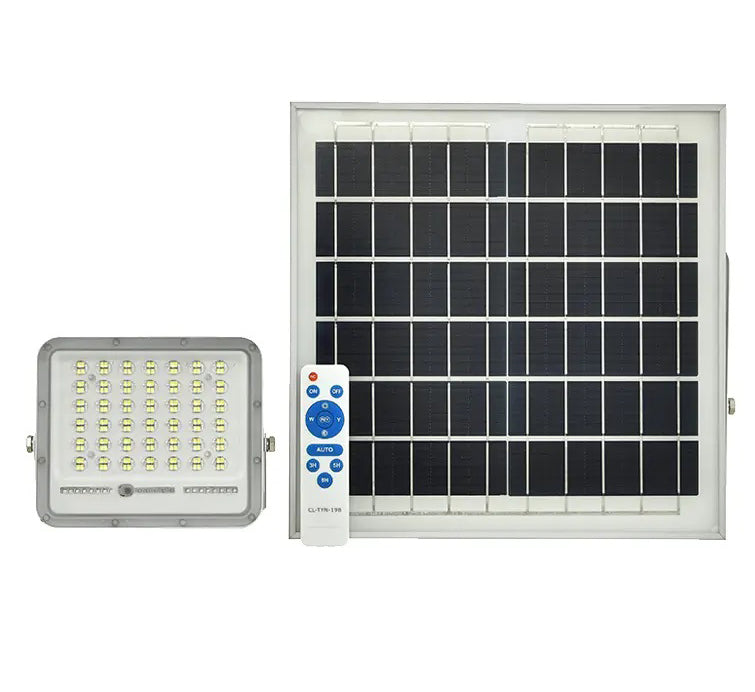
Our current flood fixture is a 100 W unit producing 2,300 lumens at 6000K, on a lithium-ion battery with remote control and an IP65 housing, at ₹6,600. The lower-wattage flood fixtures were withdrawn in 2026; the sizing guidance below still describes the full range you will meet in the market, so you can judge where 100 W sits. Shinesun manufactures and supplies outdoor solar flood lights from Bangalore across India.
Two different classes of flood light
Buyers are often surprised that one flood light can cost several times what another of the same wattage does. It is not a pricing error — this range contains two genuinely different classes of product, and the wattage on the label is the least useful way to tell them apart.
Compact remote-controlled fixtures
Lithium-ion battery, integrated panel, remote control, IP65 housing, roughly Rs 3,500 to Rs 6,600. These suit a gate, a driveway, a shop front or a building face — anywhere the light is wanted for part of the evening rather than dusk to dawn at full output. They install in minutes and need nothing but a wall and sun.
Project-grade LiFePO4 fixtures
LiFePO4 batteries from 50Ah to 100Ah, separate panels, roughly Rs 15,000 to Rs 21,000. Our 50W fixture produces 8,000 lumens on a 100Ah battery. These are specified for a compound, a warehouse yard or an industrial perimeter that must be lit reliably every night through the monsoon. The cost difference is almost entirely battery and panel capacity, which is exactly where reliability comes from.
Choosing between them is a question of duty, not brightness. If the area must be lit every night regardless of weather, the second class is the only honest answer.
Sizing and mounting
| Wattage | Output | Mounting height | Typical area |
|---|---|---|---|
| 20–25 W | 1,600–3,200 lm | 2.5–3.5 m | Gate, driveway, shop front (not in our range) |
| 40–50 W | 4,800 lm | 3.5–5 m | Courtyard, small yard, facade (not in our range) |
| 100 W | 2,300 lm | 5–7 m | Parking area, compound, perimeter — our 100 W fixture |
Mount high enough that the beam spreads before it reaches the ground, and angle down rather than out. A flood light aimed horizontally lights the neighbours and dazzles anyone approaching, which defeats the security purpose it was usually bought for.
What to check before buying
- Lumens, not watts. This range makes the point plainly: a 40W fixture here produces more lumens than a 100W one. Wattage describes draw, not light.
- Battery chemistry and Ah. The single largest determinant of whether it still works in year four.
- IP rating. IP65 minimum outdoors; IP66 for coastal or driven-rain sites.
- Whether the panel is integrated or separate. Separate panels can be angled and placed in sun independently of where the light is needed — a significant advantage on a shaded wall.
Price in India (2026)
- ₹6,600 — our 100 W fixture, lithium-ion, with remote and an integrated panel.
- ₹15,000–21,000 — project-grade LiFePO4 fixtures with 50Ah to 100Ah batteries and separate panels. We quote these to specification rather than holding them in stock.
100 watt solar flood lights
100 W is the size most people search for, and it is worth being clear about what the number means on a solar fixture.
On a mains LED flood light, wattage is what the fixture draws from the supply, and 100 W of modern LED produces something like 10,000 to 13,000 lumens. On a solar flood light, everything the fixture emits overnight has to be collected by its own panel that day, so a 100 W solar unit produces considerably less — our 100 W outdoor fixture is rated at 2,300 lumens.
That is not a defect and it is not specific to us; it is the physics of the format. But it does mean you cannot compare a solar flood light to a mains one on wattage, and you should not compare two solar flood lights that way either. Ask for lumens. A supplier who will not state them is telling you something.
Solar flood light or mains LED flood light
The honest comparison, because both have a place.
| Solar | Mains LED | |
|---|---|---|
| Output for the money | Lower | Much higher |
| Installation | Two bolts | Cable, spur, electrician |
| Running cost | Nil | Metered |
| Works in an outage | Yes | No |
| Best where | No supply nearby, or supply is unreliable | Supply is at hand and output matters most |
If a socket is already on the wall you want to light, a mains flood light will give you more light for less money. Solar wins where the cable does not exist — a compound wall, a yard boundary, a site with no connection — and where the light has to work during a power cut, which for a security installation is precisely when it matters.
Installation and cost
Wall or pole bracket, two fixings, no wiring. Mount high enough that the beam spreads before it reaches the ground, and angle downward rather than outward: a flood light aimed horizontally dazzles anyone approaching and lights the neighbours, which is the opposite of a security outcome.
For the project-grade fixtures with separate panels, allow for a short cable run from panel to fixture and keep it short — voltage drop over a long thin cable costs charging current.
Maintenance
Clean the panel every two to three months; on a yard or industrial site, more often, because dust load is higher than in a garden. Check the housing seal annually on IP65 fixtures — a perished gasket is the usual route for monsoon water to reach the electronics, and it is a cheap part to replace before it fails rather than after.
Related collections
- Solar street lights — for roads and driveways rather than areas.
- Solar wall lights — smaller motion sensor fixtures for walls and passages.
- Solar panels — replacement and add-on panels.
Frequently asked questions
What is the difference between a solar flood light and a street light?
Beam shape. A street light throws a long narrow pattern along a road so poles can be spaced widely. A flood light throws a wide beam to cover an area. Using one for the other job wastes most of the light.
How high should an outdoor solar flood light be mounted?
2.5 to 3.5 m for compact fixtures at a gate or shop front, 3.5 to 5 m for a courtyard, and 5 to 7 m for a parking area or compound. Angle it downward — a flood light aimed horizontally dazzles rather than lights.
Does a 100W solar flood light give more light than a 40W?
Not necessarily, and in this range not always. Compare rated lumens rather than wattage. Wattage tells you what the LED draws; lumens tell you what comes out.
Will it run all night?
The project-grade LiFePO4 fixtures are sized for dusk-to-dawn operation. The compact remote-controlled fixtures are designed for part-evening use, which is why their batteries are smaller and their prices lower.
Lighting a compound or yard?
Send us the area dimensions and mounting points available, and we will confirm the wattage, the number of fixtures and the battery capacity your site actually needs.