
Planning Solar Lighting for Gated Societies: A Guide to Pole Spacing and Lux Levels
Shinesun's editorial team writes about solar lighting based on our manufacturing, installation, and field-service experience across India.
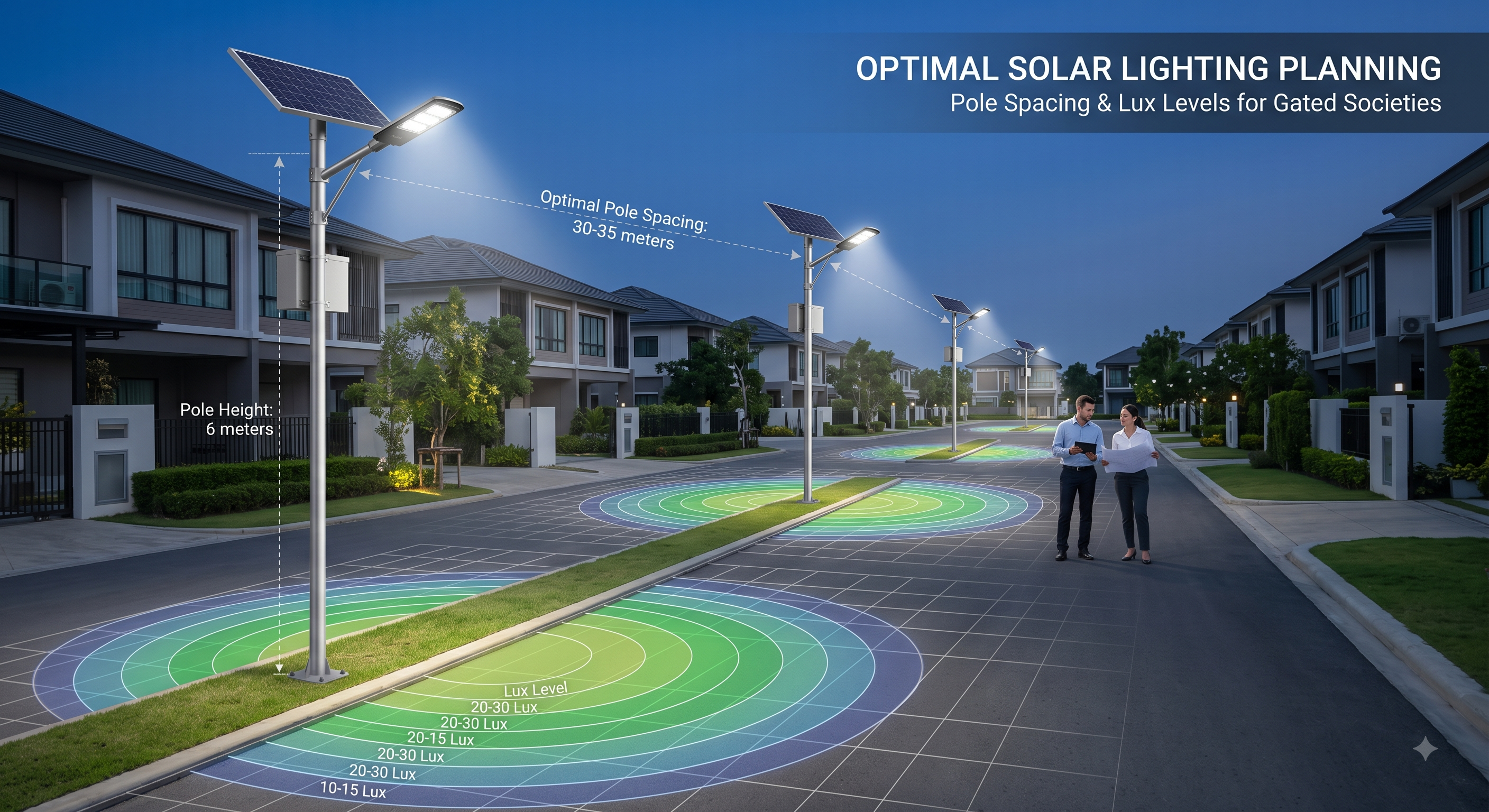
For facility managers, property owners, and municipal planners upgrading campus infrastructure, lighting is about more than just aesthetics—it is a critical security and safety requirement. When shifting from traditional grid-dependent lighting to off-grid solutions, precision in planning is everything. To achieve seamless, automated dusk-to-dawn coverage without creating hazardous dark spots, the focus must move beyond simply selecting a fixture. It requires a concrete understanding of realistic performance metrics, specifically the calculation of optimal lux levels across various pole heights and layouts.
Understanding Lux Levels for Residential Layouts
While lumens measure the total light emitted by a solar street light, lux measures the actual light intensity that reaches the ground. One lux equals one lumen per square meter. In gated societies, a uniform distribution of light is essential to eliminate shadowy pockets between poles.
Different zones within a residential layout require different lux thresholds to ensure safety and usability:
Main Gates & Security Checks (20 - 30 Lux): These are high-visibility areas requiring clear identification of vehicles, license plates, and faces.
Internal Arterial Roads (10 - 15 Lux): This level is ideal for standard vehicular movement and primary navigation routes inside the layout.
Pedestrian Pathways & Parks (5 - 10 Lux): This provides comfortable ambient illumination for walking, jogging, and general nighttime safety.
Calculating Pole Spacing and Height
The effectiveness of your lighting grid depends heavily on the mounting height and the distance between poles. Mounting a fixture too high dilutes the light before it reaches the ground, while mounting it too low limits the spread, requiring more poles to cover the same distance.
The mathematical relationship between the light intensity (I) from the fixture, the distance (d) from the source, and the resulting illuminance (E) on the ground is dictated by the inverse-square law:
E = I / d²
In practical application for street lighting, to maintain continuous coverage and achieve the necessary illumination without dark zones, the standard rule of thumb for pole spacing is generally 2.5 to 3 times the height of the pole.
4-Meter Poles: Ideal for pedestrian pathways and small garden areas. The optimal spacing between these poles should be roughly 10 to 12 meters.
6-Meter Poles: The standard choice for internal vehicular roads within gated communities. To maintain a consistent 10-15 lux, space these poles 15 to 18 meters apart.
8-Meter Poles: Best reserved for main entryways or wider, double-lane avenues. These should be spaced 20 to 24 meters apart, utilizing high-wattage fixtures to push the light down effectively.
Maximizing Efficiency with Smart Motion Sensors
Maintaining a high lux level continuously throughout the night demands massive battery reserves, which is often inefficient. Modern solar street lights utilize smart motion-sensing technology to balance high performance with self-sufficient illumination.
During the primary active hours, the lights provide maximum brightness. In the late night, the intelligent controller dims the fixture to a base level (e.g., 20% brightness)—maintaining a foundational 2 to 3 lux to prevent total darkness. The moment a pedestrian or vehicle enters the sensor's range, the light instantly scales up to 100% brightness. This automated management dramatically conserves energy, ensuring the lights reliably operate from dusk to dawn even during extended overcast periods.
Off-Grid Reliability and Ease of Installation
One of the most significant advantages of integrating off-grid solar street lights into a facility's infrastructure is immunity to grid power cuts. The dedicated battery and panel configuration ensures that security and visibility remain uncompromised during unexpected blackouts.
Furthermore, upgrading a gated society to solar lighting eliminates the need for expensive, disruptive trenching and underground cabling. The ease of DIY installation allows facility teams to mount fixtures directly onto existing poles or new structures in a fraction of the time, immediately modernizing the community's infrastructure.
Ready to upgrade your infrastructure? For technical support, product guidance, and commercial bulk requirements, contact our official sales and support team directly at +91 6364058660.