
Evaluating Commercial Solar Street Light Manufacturers: Key Factors for B2B Procurement
Shinesun's editorial team writes about solar lighting based on our manufacturing, installation, and field-service experience across India.
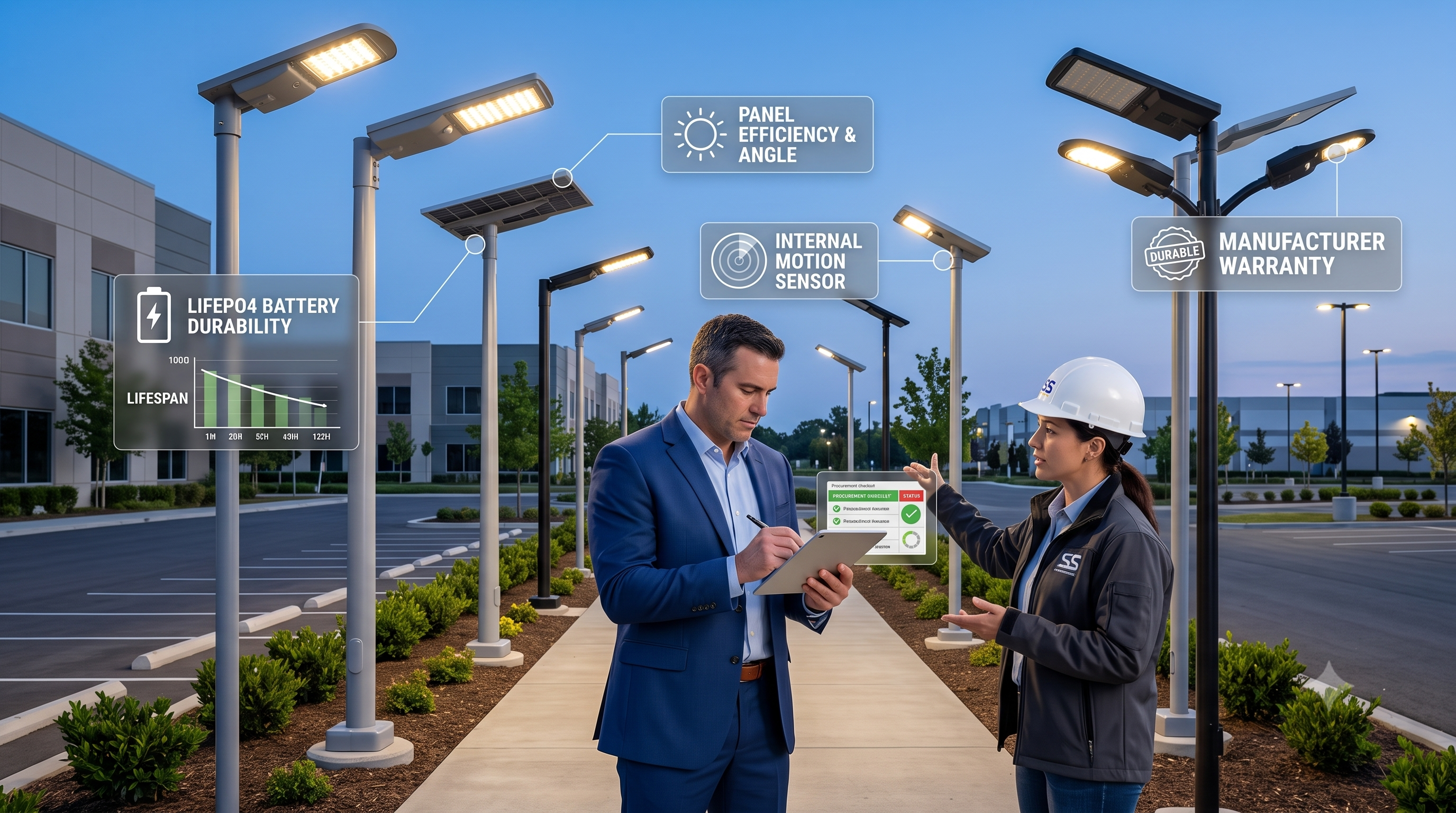
Modern Commercial Procurement Standards
For industrial park developers, municipal planners, and commercial project managers, selecting outdoor lighting goes far beyond comparing initial retail prices. In large-scale infrastructure developments, long-term reliability and total cost of ownership (TCO) dictate project success.
As commercial buyers shift away from grid-dependent fixtures, working with an experienced solar street light manufacturer who understands integrated hardware design is essential. Traditional split-system lighting—requiring separate solar panels mounted on bulky external brackets and external wiring—introduces unnecessary mechanical failure points and significant ongoing upkeep. Modern commercial projects require a unified, streamlined architectural approach.
Calculating the True Solar Street Light with Pole Price
When assessing procurement budgets, decision-makers often focus strictly on the luminaire cost. However, a complete evaluation requires analyzing the solar street light with pole price alongside deployment logistics.
Traditional grid-tied street lighting incurs massive hidden costs:
Civil Infrastructure: Heavy concrete foundation work, pavement cutting, and underground trenching.
Cabling & Electrical Labor: Expensive copper wiring running between poles and grid connection points.
Operational Downtime: Vulnerability to central power outages, transformer faults, and cable damage.
By transitioning to an all-in-one solar design, these civil engineering expenses are completely eliminated. Because the photovoltaic panel, LiFePO4 battery, and intelligent control systems are housed directly within the fixture itself, installation simply requires mounting the unit onto a standard pole. This zero-trenching advantage significantly lowers the overall cost per pole while accelerating project completion timelines.
Architectural Superiority and Engineering
Leading manufacturers design commercial luminaries to withstand extreme weather while maintaining a clean, professional aesthetic. Premium all-in-one units feature:
Flush-Mounted Photovoltaic Panels: Integrated directly into the upper surface of the housing to prevent wind resistance and physical damage.
Fully Internalized Motion Sensors: Replacing clunky, protruding external sensor bulbs with sleek, built-in radar technology.
Thermal Management Systems: Enclosing high-capacity Lithium Iron Phosphate (LiFePO4) batteries designed to maintain operational efficiency even in high-ambient temperature environments.
Investing in fully integrated solar lighting ensures commercial properties achieve robust, low-maintenance illumination that protects capital expenditure for years to come.