
The 5-Year ROI of Commercial Solar Street Lighting: Why Smart Businesses Are Switching
Shinesun's editorial team writes about solar lighting based on our manufacturing, installation, and field-service experience across India.
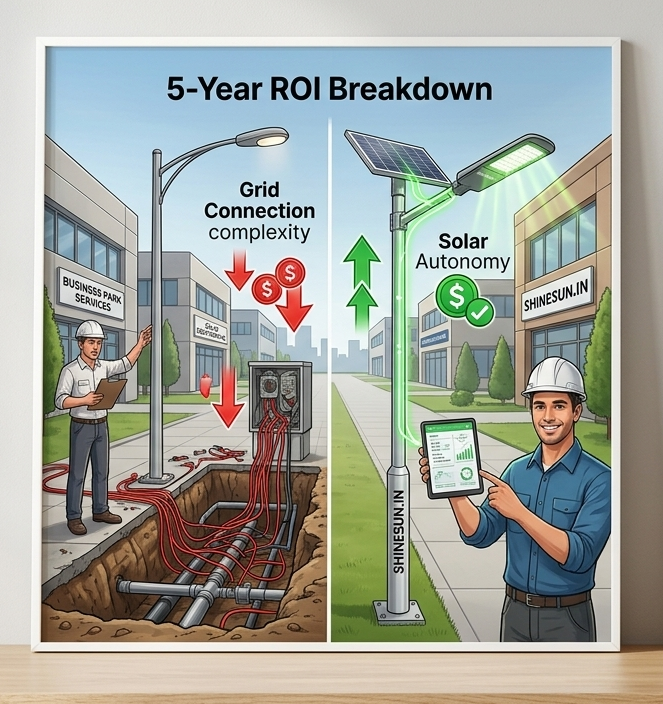
The Shift from Grid-Tied to Off-Grid Infrastructure
For commercial property managers, housing societies, and municipal planners, upgrading outdoor lighting is a major financial decision. While the initial hardware cost of a solar street light might be slightly higher than a conventional LED street light, the long-term economics strongly favor solar infrastructure.
When analyzing the Total Cost of Ownership (TCO) over a standard five-year period, solar street lights prove to be significantly cheaper. This is driving massive adoption across industrial parks, large campuses, and government projects.
Eliminating Hidden Civil and Cabling Costs
The true cost of a traditional grid-tied street light is rarely just the pole and the lamp. Deploying conventional street lights requires extensive underground cabling, which can add between ₹10,000 to ₹20,000 per pole in civil and trenching costs alone.
Solar street lights bypass these expenses completely. Because each pole operates as a standalone power plant, they require zero underground cabling. This allows for rapid deployment without tearing up existing concrete driveways or landscaped perimeters.
The 5-Year Electricity Cost Advantage
The operational savings of solar lighting become abundantly clear when looking at monthly utility bills. A conventional grid-tied street light incurs an estimated 5-year electricity cost of ₹7,200 to ₹12,000 per single light point.
Solar street lights reduce that operational expense to zero. By completely eliminating per-unit electricity charges, large commercial premises and housing societies that pay commercial electricity tariffs see a rapid return on investment.
Reliable Dusk-to-Dawn Performance
Modern commercial solar lights are engineered for consistent reliability, not just raw output. They are designed for standard overnight switch operation, utilizing smart controllers and motion sensors to manage the power draw intelligently. Instead of forcing 100% brightness all night long, the system operates at a standard 30-40% brightness when the area is clear.
When movement is detected, the light instantly steps up to maximum illumination. This smart power management significantly extends the battery life, ensuring the light remains functional from dusk until dawn, even during overcast weather or longer winter nights.
The Role of LiFePO4 Battery Technology
The most critical component in a commercial solar light is the battery. Premium systems exclusively utilize Lithium Iron Phosphate (LiFePO4) batteries. While they carry a higher upfront cost, LiFePO4 cells are lightweight, maintenance-free, and highly heat-stable, making them the optimal choice for the Indian climate. They boast a lifespan of 5+ years, drastically reducing the frequency and cost of replacement compared to cheaper lead-acid or basic lithium-ion alternatives.