
Solar Street Light FAQs (2026)
Shinesun's editorial team writes about solar lighting based on our manufacturing, installation, and field-service experience across India.
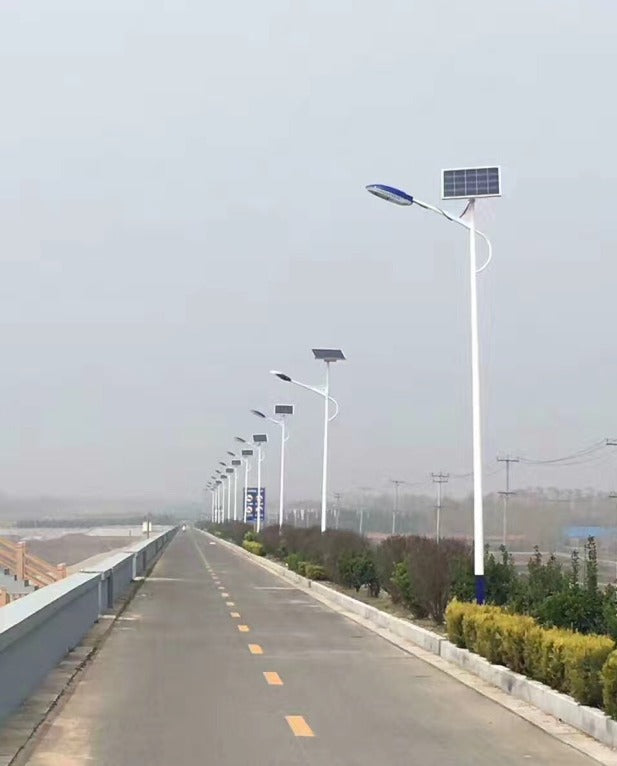
The questions buyers most commonly ask before purchasing or installing solar street lights, answered for 2026 conditions. For more in-depth coverage on any topic, follow the linked articles.
Performance and lifespan
How long do solar street lights last?
Quality fixtures with LiFePO4 batteries deliver 8-10 years before battery replacement is needed. Panels last 25-30 years; LED chips 50,000+ hours; driver electronics 8-10+ years. See durability of solar street lights.
How long do solar lights stay on at night?
A properly sized fixture runs a full Indian night (~12 hours). Motion sensors effectively double useful hours by dimming when nothing's around. See how long do solar lights stay on.
Do solar lights work in monsoon?
Yes — quality fixtures have 2-3 days of battery autonomy and panels still produce 20-40% output in heavy cloud. See solar lights in imperfect sunlight.
Do solar street lights need direct sunlight?
The panel needs direct sun for most of the day for optimal charging. Cloudy conditions still produce useful charging. Shaded sites (under tree canopy, north walls) are a problem — site selection matters more than fixture quality in these cases.
Installation and setup
How are solar street lights installed?
Most pole-mounted fixtures: excavate foundation, set pole with concrete (cure 7-14 days), mount fixture, connect earth, commission at dusk. Typically a half-day per pole for 6-8m installations. See installation guide.
Do I need an electrician?
For residential garden, wall, gate fixtures — usually DIY or basic handyman. For pole-mounted street lights — pole installation requires proper foundation and lifting; an electrician/installer for commercial scale. No DISCOM electrical work required because there's no grid connection.
What pole height should I use?
Match to your application: 3-4m for paths, 6-8m for residential streets, 8-9m for commercial, 9m+ for arterial. See pole height guide.
What spacing between fixtures?
Rule of thumb: spacing equals 3-4× pole height. A 6m pole spaces 18-24m. Tighter for uniform lighting; wider for cost optimisation.
Cost and value
How much do solar street lights cost?
Residential 40W fixture: ₹7,000-12,000. Commercial 60-100W: ₹12,000-25,000. Heavy commercial 150W+: ₹25,000-40,000+. See price list.
Are solar lights worth the cost?
For outdoor lighting in 2026 India, almost always yes. Payback typically 3-5 years; lifetime savings substantial. See are solar lights worth it.
Is there a government subsidy?
Limited for off-grid street lighting. PM Surya Ghar Muft Bijli Yojana applies to rooftop solar, not street lights. Some state-level rural schemes exist.
Components and technology
What battery is best?
LiFePO4 for any street light meant to last. Li-Ion acceptable for compact gate lights. Avoid lead-acid in new fixtures. See battery types.
What's the difference between PWM and MPPT?
MPPT extracts 20-30% more energy than PWM in cloudy conditions. Standard on quality fixtures above 30W. See PWM vs MPPT.
Mono vs poly solar panel?
Monocrystalline is the 2026 standard — higher efficiency, longer life, better low-light performance. See solar panel types.
What's an all-in-one solar street light?
Panel, battery, LED, controller, sensors integrated into a single sealed unit mounted at the pole top. The 2026 default; replaces older split-component designs. See all-in-one solar street lights.
What's a motion sensor and do I need one?
A sensor that detects movement and triggers the fixture to ramp from dim to full output. Standard on quality 2026 fixtures; doubles useful battery hours. Yes, you want one. See motion sensors.
Maintenance
How much maintenance do solar lights need?
Panel cleaning every 2-3 months; annual visual inspection; battery replacement at year 8-10 for LiFePO4. Far less than grid alternatives. See maintenance guide.
How do I clean the solar panel?
Soft cloth or sponge with plain water. No detergent for routine cleaning; diluted dish soap for stubborn dirt. Never use abrasive pads or high-pressure water.
When should I replace the battery?
LiFePO4 at year 8-10 when it starts losing capacity (symptoms: shorter useful night, fixture fails to recover after cloudy spells). Li-Ion compact fixtures at year 4-6.
What if my solar light stops working?
Most "not working" issues trace to: dirty panel (clean it), aged battery (replace), shading (relocate or trim trees), water ingress (often requires fixture replacement), or sensor failure (service).
Applications
Can solar street lights be used in gardens?
Yes, particularly larger gardens needing area lighting rather than just decorative accents. Use lower-wattage fixtures and warm-white where available. See solar street lights in gardens.
Are solar lights bright enough for streets?
Quality fixtures deliver light comparable to grid-tied LEDs at equivalent wattage. A 40W solar fixture matches a 100W+ HID street light from the 2000s in light output.
Can I use solar lights in rural areas?
Solar lighting is ideally suited to rural deployment — works through grid outages, no cabling needed, low maintenance. See solar lights for rural areas.
Will solar lights work in commercial settings?
Yes, particularly well — commercial tariffs make solar economically attractive faster, and no DISCOM coordination is needed for new fixtures. See commercial solar street lights.
Other common questions
Are solar street lights safer than grid lights?
Yes. Solar fixtures operate at 12V (or lower for compact units); grid fixtures at 230V AC. Damage to solar fixtures doesn't create the same shock hazard.
Do solar lights need lightning protection?
For tall poles (8m+) or exposed sites, yes — surge protection device (SPD) in the fixture and proper earthing. For residential gardens, basic earthing recommended. See lightning protection.
Can solar lights replace grid lights entirely?
For outdoor lighting (street, garden, gate, flood) — almost always yes. For indoor primary lighting — no, grid LED is the right answer. Solar excels at outdoor and emergency / backup applications.
How environmentally meaningful is switching to solar?
India's grid is ~70% fossil. Each 40W solar fixture displaces ~120 kg CO2/year vs grid alternative. At commercial scale, this becomes measurable ESG impact.
Got a question not covered here?
Contact the Shinesun team with your question and we'll respond. For specific product specifications, see individual product pages on the site.