
Types of Solar Panels Used in Solar Lights (2026)
Shinesun's editorial team writes about solar lighting based on our manufacturing, installation, and field-service experience across India.
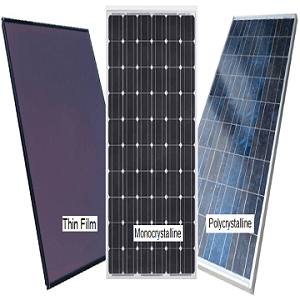
The solar panel is the energy source for the whole fixture — and the quality and type of panel directly determines whether the light works through monsoon, mid-winter, and the dust accumulation of an Indian summer. Three panel technologies appear in solar lights in 2026, but only two matter for practical street and garden lighting.
Monocrystalline (the 2026 standard)
Made from a single silicon crystal, monocrystalline panels deliver the highest efficiency in commercial production — currently 20-23% in mainstream module formats. In a solar light, this matters because:
- More watts per square cm of panel area — smaller, lighter panels for the same output
- Better low-light performance (cloudy days, partial shade)
- Longer life — 25-30 years of usable output
- Less sensitive to high-temperature derating in Indian summer
Visual identifier: uniform dark colour, with rounded-corner cells. Modern modules often hide the cell edges entirely behind black-frame styling. The Solar Bat 40W and most quality 2026 street lights use monocrystalline.
Polycrystalline (legacy / budget)
Made from multiple silicon crystal fragments, polycrystalline panels are cheaper to manufacture but lower efficiency — typically 15-18%. In solar lights, polycrystalline is found in:
- Budget fixtures targeting lowest entry price
- Older fixture designs still in market
- Some thin-margin imported products
The efficiency gap means polycrystalline panels need to be ~25% larger for the same watt output, which limits where they fit. Visual identifier: blue-tinted colour with visible irregular crystal grain pattern.
Polycrystalline isn't bad — it works fine — but in 2026 the price gap with monocrystalline has shrunk enough that there's little reason to specify it new. See mono vs poly comparison.
Thin film (rarely used in lights)
Thin-film panels (amorphous silicon, CIGS, CdTe) have low efficiency but flexible form factors. Rarely used in solar street lights in 2026 because:
- Efficiency 8-12% — too low for compact fixture designs
- Shorter lifespan than crystalline silicon
- Cost advantage has largely evaporated
You may see thin-film panels in novelty products (solar-charging bags, flexible decorative fixtures) but not in serious lighting applications.
What matters more than panel type
Panel-to-LED wattage ratio
Far more important than panel technology. Quality fixtures size the panel at 2-3× LED wattage. A 40W LED needs an 80-120W panel regardless of whether that panel is mono or poly.
Actual measured output vs nameplate
Cheap fixtures often nameplate the panel as "100W" but the actual output is much less. Verifiable specs include cell count, cell size, and measured short-circuit current.
Anti-reflective coating and surface finish
Quality panels have anti-reflective coatings that improve low-angle performance (morning and evening sun). Budget panels often skip this.
Encapsulation and weather sealing
EVA encapsulation, tempered glass front, weatherproof junction box — these matter for 10-year durability in Indian conditions.
Mounting and orientation
Even the best panel underperforms if mounted wrong:
- Tilt — equal to latitude for year-round optimal (about 20-28° for most of India)
- Orientation — south-facing for fixed-mount installations in India
- Shading — even partial shade on one cell can disable a whole string. Site selection matters.
All-in-one fixtures fix the panel orientation at the top of the pole, so site selection (not blocked by trees or buildings) is the variable.
Buying guidance
- Insist on monocrystalline for any new fixture intended for 8+ year service
- Verify panel-to-LED ratio at 2-3× minimum
- Check the warranty — quality panels carry 25+ year linear performance warranty
- Verify the actual wattage — ask for measured Isc and cell count, not just nameplate
Shinesun's panels
Shinesun fixtures use monocrystalline panels sized to the LED rating, with anti-reflective coating and tempered glass front, rated for Indian outdoor conditions. For specific panel specs on individual fixtures, see product pages or contact the team.