
Best All-in-One Solar Street Lights in India (2026)
Shinesun's editorial team writes about solar lighting based on our manufacturing, installation, and field-service experience across India.
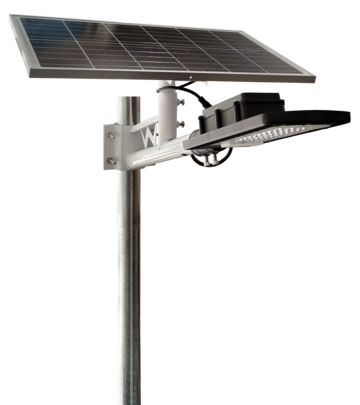
All-in-one (or integrated) solar street lights bundle the solar panel, battery, LED, controller, and sensor into a single sealed unit mounted at the top of the pole. They dominate the 2026 Indian solar street light market — for good reasons. Here's what makes an all-in-one fixture worth buying versus one to avoid.
Why all-in-one became the default
Older split-design fixtures had the panel up high, battery in a box at the base, and LED head separately mounted. This required field wiring, made theft easier (ground-level lead-acid batteries had scrap value), and added installation time. All-in-one fixtures fix all of this:
- Single-unit installation — mount the bracket on the pole, attach the fixture, done. Often under an hour per pole.
- No external wiring — internal connections only, lower failure rate
- Theft-resistant — no accessible battery; everything's sealed at pole top
- Cleaner appearance — modern industrial look vs cluttered split fixtures
- Better waterproofing — single sealed enclosure rather than multiple junction points
What separates a good all-in-one from a bad one
Battery chemistry
LiFePO4 for any fixture meant to last 8+ years. Li-Ion acceptable for compact fixtures. Lead-acid is a hard pass on new fixtures in 2026. See lithium-ion batteries.
Panel sizing (2-3× LED wattage)
The single biggest quality differentiator. Budget all-in-ones often undersized the panel to hit a price point — they look fine at purchase, fade after a season.
Monocrystalline panel
Higher efficiency means more watts per pole-top area, which matters for a compact integrated form factor.
MPPT charge controller
20-30% efficiency boost over PWM in cloudy conditions. On a marginal-light day in monsoon, the difference between "still works" and "battery starved." Standard on quality fixtures above ~30W.
Motion sensor (PIR or microwave)
Standard on all quality 2026 fixtures. Doubles useful battery hours. See solar street lights with motion sensor.
IP66 rating
IP65 minimum; IP66 for monsoon and coastal sites. Below IP65 is for sheltered locations only.
LED chip quality
Branded LEDs (Bridgelux, Lumileds, Osram) deliver 130-160 lumens per watt. No-name LEDs fade and discolour in 1-2 years.
Aluminium / die-cast housing
Plastic housings degrade in Indian sun. Powder-coated aluminium or die-cast metal lasts decades.
Wattage selection for all-in-one fixtures
- 15-20W all-in-one — pathways, garden zones, small compounds (3-4m pole)
- 30-40W all-in-one — residential streets, society internal roads (6-7m pole) — the most common installation. The Solar Bat 40W typifies this band.
- 60-80W all-in-one — wider commercial roads, industrial parking (7-8m pole)
- 100-150W all-in-one — wider main roads, industrial yards (8-9m pole)
Where all-in-one isn't the right choice
- Heavily shaded poles — if the panel orientation isn't right at the pole top, a split design lets you place the panel separately
- Very high-output fixtures — above 200W, the panel size required typically exceeds what fits on a pole top; split design becomes more practical
- Configurable installations — research, demonstration, or unusual sites where component-level access matters
What to verify before buying an all-in-one
- LiFePO4 battery (state chemistry on datasheet)
- Monocrystalline panel sized at 2-3× LED wattage
- MPPT controller (above 30W)
- Motion sensor with disclosed dim-state brightness and hold time
- IP66 housing
- Branded LED chips and disclosed lumens at rated wattage
- Aluminium or die-cast housing
- Documented warranty terms (typically 5 years panel, 2-5 years battery, 2 years driver)
If a supplier can confirm all eight, you're looking at a quality fixture. If they hedge on any, it's worth asking why.
Common all-in-one mistakes
- Buying on wattage alone — a quality 40W beats a budget 80W on practical output
- Ignoring the panel-to-LED ratio — the panel is the foundation of the system
- No-name brands with marketplace-only presence — service and warranty become impossible
- Aggressive low pricing — quality 40W all-in-one fixtures don't cost ₹3000. If a seller quotes that, something's been cut
Shinesun's all-in-one range
Shinesun supplies all-in-one solar street lights across the 15W-150W band, with LiFePO4 batteries, monocrystalline panels, MPPT controllers (above 30W), motion sensors, and IP66 housings as standard. See the solar street lights collection, or contact the team for specific recommendations.