
Solar Street Light with Motion Sensor in India (2026)
Shinesun's editorial team writes about solar lighting based on our manufacturing, installation, and field-service experience across India.
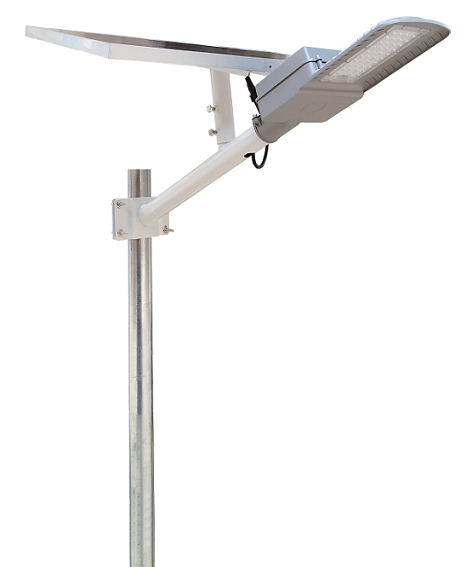
Motion sensors are the single highest-impact feature on a modern solar street light. They roughly double useful battery hours, allow brighter peak output, and reduce light pollution in residential settings. In 2026, motion sensor is a standard feature on quality fixtures rather than an upgrade. Here's how to choose and use them in Indian conditions.
How motion sensors change the math
A constant-on fixture runs at full output for ~12 hours a night. A motion-sensored fixture dims to 30% (or lower) when nothing's around, ramps to 100% on detection, then dims back. For typical low-traffic streets, this means:
- ~80% of the night at 30% output
- ~20% of the night at 100% output
- Average consumption ~40% of constant-on
That's the difference between needing a 60W fixture with a constant-on design and a 40W fixture with motion sensor for the same lit-area performance — at lower cost and with longer battery life.
Motion sensor types — what's actually in the market
PIR (passive infrared)
Detects heat-emitting objects moving across the sensor's field. Most common type, lowest cost, mature technology.
- Detection range — typically 4-8m
- False trigger sources — wind-driven heated objects, animals, leaves
- Strengths — proven, cheap, reliable in moderate conditions
- Weaknesses — can miss slow-moving or directly-approaching targets; sensitivity to ambient heat
Microwave radar
Detects movement via radar reflection. Newer in solar street lighting, increasingly common in premium fixtures.
- Detection range — typically 8-15m
- False trigger sources — vegetation movement, vehicles passing further away
- Strengths — longer range, can detect through some obstacles (light foliage, plastic enclosures), works in extreme heat/cold
- Weaknesses — costlier, can trigger on distant movement
Dual / hybrid (PIR + microwave)
Both sensors must trigger for full output — dramatically reduces false triggers. Used in premium and security-focused fixtures.
What "intelligent sensor" usually means
Many fixtures market "intelligent sensor" — usually meaning a sensor + scheduled dimming profile. Typical behaviour:
- Dusk to 10pm — full output (peak activity hours)
- 10pm to midnight — 70% baseline, full on detection
- Midnight to 4am — 30% baseline, full on detection
- 4am to dawn — 50% baseline, full on detection
Tuning the schedule to your specific traffic pattern further extends battery hours.
Sensor tuning for Indian conditions
- Hot summer ambient — high baseline temperature reduces PIR contrast; microwave is more reliable above 40°C
- Monsoon — both sensors work; PIR can briefly false-trigger on heavy rain
- Stray animals (cattle, dogs) — common nighttime traffic in India; both sensor types will trigger
- Wind-driven vegetation — adjust sensor sensitivity if frequent false triggers from nearby trees
Where motion sensor matters most
- Residential streets — low overnight traffic, big battery savings
- Society / gated community internal roads — intermittent traffic
- Industrial yards and perimeters — long stretches with minimal activity
- School and educational campuses — quiet overnight, busy at fixed times
- Pathway and walkway lighting — only on when needed
Where constant-on may be preferable
- High-traffic main roads — sensors would be triggered constantly anyway
- CCTV-monitored areas — consistent lighting helps camera performance
- Critical safety zones — pedestrian crossings, entry/exit points
Even in these, scheduled dimming (rather than full motion) often gives the right balance.
What to verify before buying
- Sensor type — PIR vs microwave vs dual
- Detection range — appropriate for pole height and area
- Dim-state brightness — typically 20-30%; ensures fixture is still visible
- Ramp-up speed — should be near-instant for safety
- Hold time — how long the fixture stays bright after last detection (typically 30-60 seconds)
- Adjustability — premium fixtures allow sensitivity and timing adjustment
Shinesun's motion-sensor fixtures
Motion sensor is standard on Shinesun's street light range, including the Solar Bat 40W and larger fixtures. Sensor type and tuning are selected for the rated wattage and typical use case. For specific sensor questions or commercial requirements, contact the team.