
Installation of Solar Lights — A 2026 Practical Guide
Shinesun's editorial team writes about solar lighting based on our manufacturing, installation, and field-service experience across India.
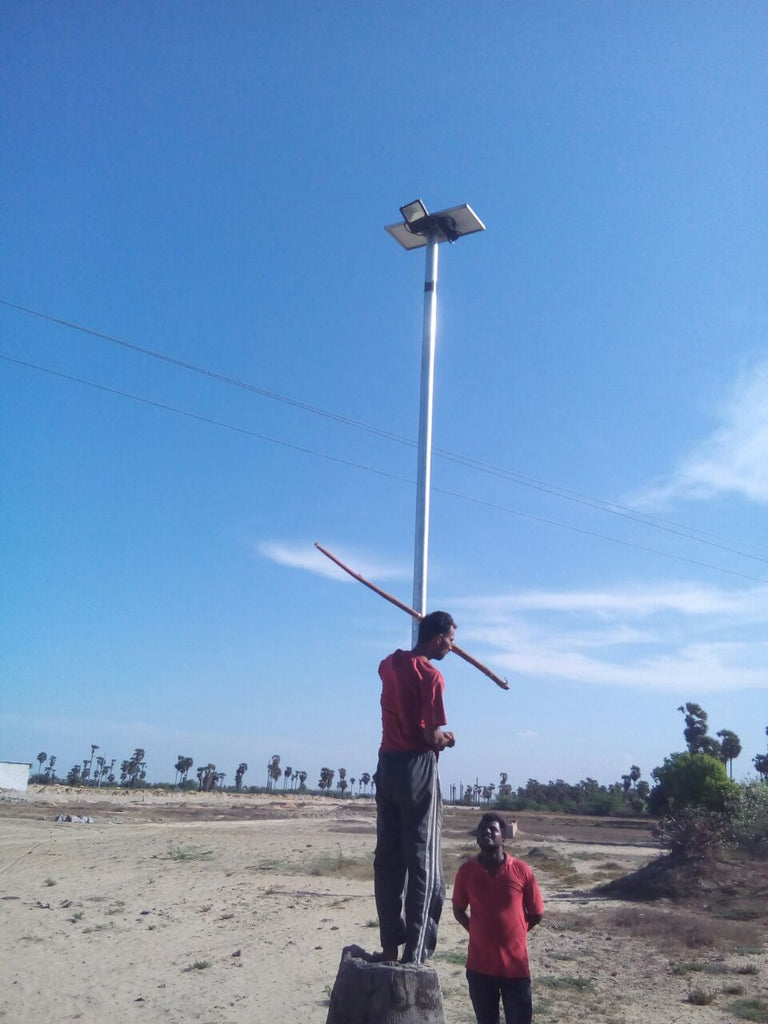
Installing a solar light is dramatically simpler than installing a grid-tied alternative — no trenching, no DISCOM paperwork, no wiring back to a circuit. But "simpler" isn't "no effort." A bad install causes 80% of "solar doesn't work" complaints. Here's the 2026 practical guide to installing solar lights properly.
Before you install — siting matters most
The single biggest determinant of success or failure is where you mount the fixture. Before you order:
- Sun exposure — the panel needs direct sun for most of the day. Walk the site at 10am, noon, and 3pm; verify no shading at any of these times.
- Future shading — that tree at the edge of the property in 2026 may grow to shade the panel by 2030. Plan accordingly.
- Building shadows — north-facing walls of tall buildings cast long shadows. Avoid.
- Local obstruction — neighbouring construction, billboard, or signage that may grow in.
- Mounting surface — soil for ground-mounted poles; structural wall for wall fixtures; verify load capacity.
If you can't site for clean south-facing sun, consider whether a different location works better. Forcing solar onto a shaded site rarely ends well.
What to install at each scale
Small fixtures (gate lights, wall lights, garden stake lights)
Most install in under an hour. Wall fixtures need:
- Wall plugs sized for the wall material (concrete, brick, hollow block)
- Drill bit matching the plug
- Screwdriver or impact driver
- Spirit level (for visible-from-distance fixtures)
Stake lights push into garden soil — no tools needed for installation itself, but firm soil contact is necessary for stability.
Pole-mounted street and garden lights (3-9m)
The serious installation category. Steps:
- Mark the foundation location — verify position, sun exposure, distance from other fixtures
- Excavate the foundation pit — typically 0.6m × 0.6m × 0.8m for 4-6m poles; deeper for taller
- Lay foundation — M25 concrete with anchor bolts cast in to the pole-base specification
- Cure — full concrete cure typically 7-14 days before mounting load
- Earth electrode — drive copper rod or plate into conditioned soil adjacent to foundation; connect to pole base after install
- Mount the pole — usually requires 2-3 people for 6m+ poles, a vehicle-mounted crane or block-and-tackle for 9m+
- Tighten anchor bolts — to manufacturer-specified torque
- Mount the fixture — bracket and bolts, with adjustments for tilt and rotation
- Earth connection — connect fixture earth to pole earth
- Cover and seal junction — pole-fixture interface against weather ingress
- Commission — verify fixture switches on at dusk, motion sensor triggers correctly
Heavy commercial installations (9m+, multi-pole)
Engineered foundations, lifting equipment, often specialist installation contractors. Most quality suppliers offer or coordinate installation services for commercial scale. See commercial solar street lights.
Critical install details often missed
Foundation cure time
Concrete foundation needs full cure before pole loading. A rushed install puts wind-load stress on green concrete; pole alignment shifts within months.
Anchor bolt torque
Under-tightened anchor bolts cause pole wobble in wind, leading to alignment drift and connection failure. Over-tightened can crack the foundation. Use a torque wrench to manufacturer spec.
Earth connection
The single most-skipped install step on residential projects. Even a basic earth rod gives meaningful surge protection. Skipping earthing in lightning-prone regions guarantees future fixture failures.
Panel orientation
For all-in-one fixtures, the panel is at a fixed angle relative to the housing. Mount the fixture so the panel faces south at the right tilt. Trivial in flat sites; needs care on slopes or curved roads.
Cable entry sealing
If you're connecting external cables (rare in true all-in-one fixtures, more common in split designs), the cable entry is the highest-risk leak point. Use proper IP-rated cable glands; don't rely on silicone alone.
Commissioning at night
Verify the fixture turns on at dusk, runs through the night, and turns off at dawn. Confirm motion sensor triggers and ramp behaviour. Many issues only become apparent after dark on the first night.
Common installation mistakes
- Mounting in shade — panel can't charge; fixture fails within weeks
- Foundation undersized — pole leans within first monsoon
- Skipping earthing — fixture damaged on first thunderstorm
- Wrong panel orientation — fixture works at 60% of designed output
- Bracket not torqued correctly — fixture works loose, develops wobble
- Cable gland not sealed — water ingress destroys electronics
- Multiple fixtures with no spacing planning — bright spots and dark zones along a road
Spacing between fixtures (multi-pole installations)
Rule of thumb: spacing equals 3-4× pole height:
- 4m pole — 12-16m spacing
- 6m pole — 18-24m spacing
- 8m pole — 24-32m spacing
- 9m pole — 27-36m spacing
See pole height guide.
Tools you'll need for typical pole installations
- Spade / pickaxe / earth auger for foundation excavation
- Spirit level (vertical and horizontal)
- Torque wrench for anchor bolts
- Adjustable spanner / ratchet set
- Lifting equipment (block and tackle, vehicle-mounted crane for tall poles)
- Earth resistance tester (for commercial installations)
- Multimeter for basic commissioning checks
DIY vs professional install
- Wall fixtures, stake lights, simple gate lights — DIY-appropriate
- 3-4m pole, residential garden installation — DIY with help from 1-2 others
- 6-9m pole, commercial site — professional installer recommended
- 9m+ pole, multi-pole commercial — specialist installation required
Shinesun installation support
For commercial projects, Shinesun supports site survey, foundation specification, and installation coordination. For specific installation questions or service quotes, contact the team.