
Uses of Solar Energy in India (2026)
Shinesun's editorial team writes about solar lighting based on our manufacturing, installation, and field-service experience across India.
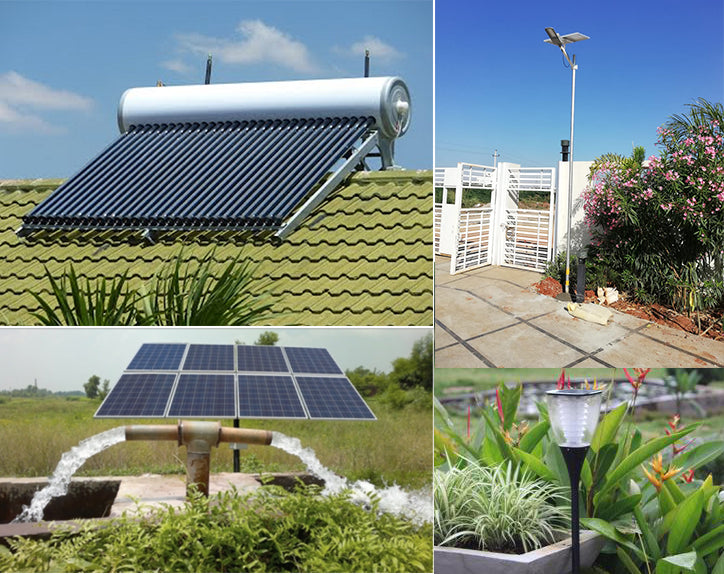
Solar energy in India has moved from "future technology" to "mainstream infrastructure" over the past decade. In 2026, solar is generating a meaningful share of national electricity, lighting tens of millions of homes, pumping water for farmers, and powering everything from school computers to vaccine refrigeration. Here's the practical view of where solar energy is actually used in India in 2026.
Utility-scale solar power generation
The biggest single use of solar in India by energy volume — solar farms feeding the grid.
- Installed capacity — ~110 GW of utility-scale solar and ~157 GW of total solar capacity in India by mid-2026; India crossed the 50% non-fossil installed-capacity share milestone in 2025
- Tariff trends — solar consistently the cheapest new generation in tariff auctions
- Land use — typically 2-2.5 hectares per MW installed
- Major states — Rajasthan, Karnataka, Tamil Nadu, Gujarat, Andhra Pradesh
- Project types — open-access, captive, utility-scale, solar parks
Utility-scale solar provides the bulk of India's clean energy transition. Not the same product category as solar street lights, but the same fundamental technology.
Rooftop residential solar
Grid-tied solar systems on individual homes — the application most likely to be visible to ordinary residential consumers.
- PM Surya Ghar Muft Bijli Yojana (launched February 2024) — government subsidy scheme: 1kW=₹30K, 2kW=₹60K, ≥3kW=₹78K
- Typical residential system — 3-5 kW
- Payback period — 5-7 years with subsidy and net metering
- Generation — 4-5 units/day per kW installed (varies by region)
- Common configurations — grid-tied without battery (most common), grid-tied with battery (backup), off-grid (rural)
Solar street and outdoor lighting
This is the use case most relevant to Shinesun's business and the one with the strongest economic case in 2026.
- All-in-one solar street lights — residential, commercial, industrial outdoor lighting
- Solar garden / wall / gate lights — residential and decorative
- Solar flood lights — security and area lighting
- Solar emergency lights — indoor backup during outages
See are solar lights worth it for the economic case.
Agricultural and rural pumping
One of the highest-impact uses of solar in rural India.
- PM-KUSUM — government scheme for solar pumps and grid-connected solar projects on farmland
- Surface pumps — for water transfer from canals, ponds, surface sources
- Submersible pumps — for borewell / tubewell irrigation
- Capacity range — 1HP to 10HP typical for farm-level applications
- Economic impact — eliminates diesel cost for irrigation; transforms farm economics in regions with weak grid
Solar water heating
A separate technology (solar thermal, not PV) but worth distinguishing:
- Flat-plate or evacuated-tube collectors heat water directly
- Common in residential, hotels, hospitals, hostels
- Often more efficient than solar PV for water heating specifically
- Different supplier ecosystem than solar PV
Solar refrigeration and cooling
- Vaccine cold chain — solar-powered refrigerators in rural health centres
- Milk chilling — for dairy collection in rural areas
- Agricultural cold storage — for produce in areas without reliable grid
- Solar air conditioning — emerging applications in commercial settings
Solar in transportation
- Solar EV charging stations — being deployed at highway service areas, parking
- Rooftop solar on EV vehicles — supplementary, not primary, charging
- Solar boats and ferries — pilot projects in inland waterways
Solar in healthcare and education
- Primary health centres and sub-centres — solar for lighting, equipment, refrigeration
- School lighting and equipment — particularly evening classes and adult education
- Anganwadis — early childhood centres in rural areas
- Telemedicine connectivity — solar for off-grid communication infrastructure
Solar for telecom and communication
- Cell tower power (particularly remote / weak-grid areas)
- Backup power for telecom infrastructure
- Rural connectivity infrastructure
Solar for industry
- Captive solar generation — factories installing rooftop or open-access solar for own consumption
- Solar for industrial processes — process heat applications
- Industrial water heating — solar thermal in textiles, food processing
- Industrial lighting and area lighting — solar street and flood lights for industrial premises
Solar in religious and community spaces
- Solar street lighting at temples, mosques, gurudwaras, churches
- Solar for community halls and panchayat buildings
- Solar for pilgrimage destinations and large public gatherings
Emerging and niche applications
- Floating solar — on reservoirs and water bodies
- Solar canal-tops — solar over canal infrastructure
- Agri-voltaics — solar over crops (combined land use)
- Solar drying — agricultural produce
- Solar bus shelters — combining lighting and charging
- Solar billboard / signage — outdoor advertising
What hasn't worked well (honest list)
- Some early floating solar pilots — water and electronics combination has been tricky
- Solar pavement / road tiles — overhyped, underperformed
- Concentrated solar power (CSP) — has lost to PV on economics in most cases
- Solar with single-day battery backup — economics often don't work vs grid + occasional outage tolerance
What's changing in 2026
- Continued cost declines in PV modules and LiFePO4 batteries
- Growing domestic Indian manufacturing capacity
- Rooftop solar adoption accelerating under PM Surya Ghar
- Solar + battery hybrid systems becoming economically attractive
- Solar street lighting moving from "premium choice" to "default choice" for outdoor
- Solar agricultural applications expanding under continuing schemes
The honest summary for Indian buyers
If you're looking at solar in 2026 for your specific use case:
- Outdoor lighting — solar is almost always the right answer
- Rooftop residential — strong economic case for most homes with usable roof space; subsidy helps significantly
- Agricultural pumping — particularly strong case in weak-grid rural areas; PM-KUSUM subsidies available
- Industrial / commercial — depends on consumption pattern, tariff, available roof or land
- Water heating — solar thermal is usually the right answer rather than solar PV
- Off-grid / remote — solar is essentially the only economical option for many applications
Shinesun's role in the ecosystem
Shinesun focuses on solar lighting — the outdoor lighting and emergency lighting applications where the economic case is strongest and the deployment is most straightforward. For solar lighting needs (street, garden, gate, flood, emergency), browse the solar street lights collection and other product ranges, or contact the team for specific recommendations.