
Lithium-Ion Batteries for Solar Street Lights (2026)
Shinesun's editorial team writes about solar lighting based on our manufacturing, installation, and field-service experience across India.
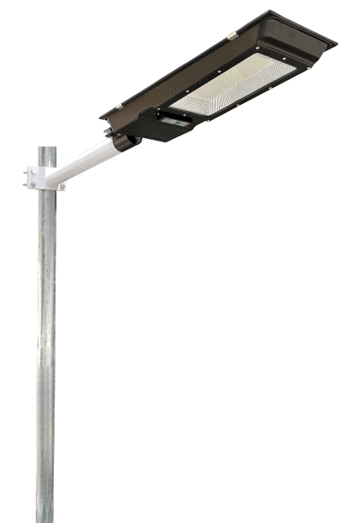
Lithium-ion was the technology that pulled solar street lighting forward — replacing lead-acid through the late 2010s with longer life, lighter weight, and faster charge acceptance. By 2026, the conversation has moved on: LiFePO4 has become the dominant chemistry for street-light scale fixtures, while traditional Li-Ion still has a place in compact applications. Here's the practical view.
The two "lithium" chemistries to know
LiFePO4 (lithium iron phosphate)
The 2026 standard for outdoor solar street lights. Key properties:
- Lifespan — 2000-4000+ charge cycles (8-10 years of typical service)
- Thermal stability — does not catch fire or vent toxic gases under fault conditions
- Wide operating range — handles Indian summer heat without significant degradation
- Lower energy density than Li-Ion (heavier per kWh) but this rarely matters in a pole-mounted application
Traditional Li-Ion (NMC, LCO)
Still appropriate for compact fixtures. Key properties:
- Higher energy density — more capacity in less weight/volume
- Shorter lifespan — 500-1500 cycles depending on chemistry and care
- Heat-sensitive — degrades faster in hot climates; rare safety risk under fault
- Lower cost per kWh at small sizes
Where each fits
LiFePO4 is right for:
- Pole-mounted solar street lights (any wattage)
- Commercial/industrial fixtures intended for 8+ year service
- Sites where battery replacement is logistically inconvenient (high-mount, remote)
- Anywhere fire safety is a priority (educational, residential, hospitality)
Li-Ion is right for:
- Compact gate lights, small wall fixtures (e.g., Volcano series)
- Indoor emergency lights where heat exposure is limited
- Portable / temporary lighting where weight matters
What changed since 2017
Solar street lights were originally lead-acid. Li-Ion came in around 2017-2019 as a clear upgrade — longer life, faster charge, no maintenance. By 2022-2024, LiFePO4 had matured enough to displace generic Li-Ion in the main street light category, on the strength of:
- ~2x lifespan in cycle count
- Much better thermal stability in Indian heat
- Faster price drops in LiFePO4 cell manufacturing
- Rising awareness of Li-Ion thermal-runaway incidents
The 2026 lineup: LiFePO4 dominates street-light scale; Li-Ion holds compact-fixture and gate-light applications; lead-acid is legacy/budget only.
How to identify what's in a fixture you're considering
Datasheets and product specs usually state battery chemistry directly. Markings to look for:
- "LiFePO4" or "LFP" — lithium iron phosphate
- "Li-Ion" / "INR" / "ICR" — traditional lithium-ion
- "NMC" — nickel-manganese-cobalt lithium-ion variant
- "SLA" / "VRLA" — sealed lead-acid (legacy)
If a supplier won't disclose the chemistry, that's a red flag.
Capacity matching
The right capacity depends on fixture wattage and required autonomy. Rule of thumb:
- Battery Wh ≥ (LED wattage × nightly hours × autonomy days × 1.3 safety factor)
- Example: 40W fixture, 12-hour night, 2-day autonomy = 40 × 12 × 2 × 1.3 = ~1250 Wh
For Indian conditions, 2-3 days of autonomy is sensible; monsoon-heavy zones lean toward 3+.
End-of-life and replacement
Both lithium chemistries can be recycled — capacity and economics of recycling vary by chemistry and region. For Shinesun fixtures, end-of-life battery replacement and recycling guidance is part of service support. Contact the team for service questions.
Shinesun's standard
Shinesun's main street light range uses LiFePO4 as the standard chemistry, sized for the rated wattage and 2-3 day autonomy. Compact gate-light fixtures (Volcano series) use Li-Ion, which is appropriate for the small enclosed format. See the solar street lights and gate lights ranges, or talk to the team.