
Solar Street Light Components and How They Work Together (2026)
Shinesun's editorial team writes about solar lighting based on our manufacturing, installation, and field-service experience across India.
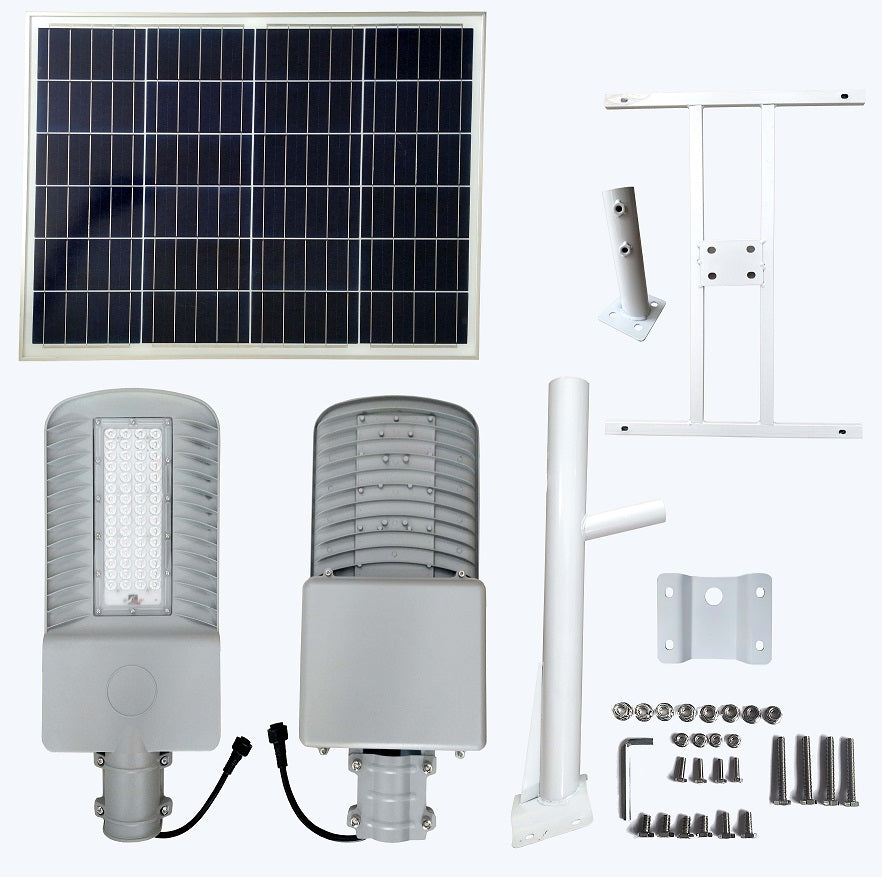
A solar street light is a small power system in a single sealed enclosure: it captures sunlight, stores it, and delivers it as light during the night. Understanding the components and how they work together helps with specifying fixtures, troubleshooting issues, and judging quality. Here's the 2026 view of what's inside.
The five core components
1. Solar panel (PV module)
Converts sunlight into electricity. The 2026 standard is monocrystalline silicon at 20-23% efficiency. Quality fixtures size the panel at 2-3× the LED wattage.
- Type — monocrystalline standard; polycrystalline legacy
- Mounting — top of pole in all-in-one fixtures; separate in split designs
- Lifespan — 25-30 years usable output
- Cleaning — every 2-3 months in dusty regions
2. Battery
Stores energy collected during the day for night use. The 2026 standard for street-light scale is LiFePO4.
- Type — LiFePO4 (street lights), Li-Ion (compact fixtures), lead-acid (legacy)
- Sizing — based on LED wattage × nightly hours × autonomy days
- Lifespan — 8-10 years for LiFePO4; 4-6 for Li-Ion; 2-3 for lead-acid
- Voltage — typically 12V (or 12.8V nominal LiFePO4)
See battery types.
3. Charge controller
Regulates power flow between panel, battery, and LED. Manages charging cycles, protects against over-charge and over-discharge, and (in modern designs) also handles LED output scheduling.
- Type — MPPT (above 30W); PWM (compact fixtures)
- Functions — charge regulation, battery protection, LED scheduling, sensor interface
- Lifespan — typically 8-10 years, sometimes longer
See charge controller PWM vs MPPT.
4. LED light source
The actual light. Modern LED packages deliver 130-160 lumens per watt; quality fixtures use branded chips (Bridgelux, Lumileds, Osram).
- Chip count — varies by fixture wattage
- Colour temperature — 5000-6500K (cool, streets), 3000-4000K (warm, residential/garden)
- Lifespan — 50,000+ hours to L70 (70% original output)
- Driver — integrated electronics regulate current to LED chips
See lumens in LED solar lights.
5. Motion sensor and LDR
Modern fixtures include sensors for automatic operation:
- LDR (light-dependent resistor) — detects dusk/dawn for automatic on/off
- PIR motion sensor — detects movement to trigger full-brightness boost
- Microwave radar (premium) — longer-range motion detection
- Combined sensor logic — LDR enables nighttime operation; PIR or microwave triggers brightness
See LDR in automatic lights and motion sensors.
Supporting components
- Housing — die-cast aluminium or steel, IP66 rated for outdoor use
- Heat sink — manages LED chip temperature; integrated into housing on quality fixtures
- Mounting bracket — connects fixture to pole; adjustable on quality units
- Wiring — internal connections between components; pre-tested in assembled fixture
- Cable glands — sealed entry points for any external cabling
- Pole — typically galvanised steel, sized for fixture height (3-12m+)
- Foundation — concrete base sized for pole height and local wind/soil
How they work together — day cycle
- Sun rises; LDR detects dawn; controller switches LED off
- Panel produces DC current proportional to sunlight
- Controller routes panel output to battery for charging
- Battery accepts charge; controller manages voltage and tapering
- Excess panel capacity is shunted (battery is full)
How they work together — night cycle
- Sun sets; LDR detects dusk; controller switches LED to dim mode (or off in basic fixtures)
- Motion sensor monitors for activity
- On detection: controller ramps LED to full output; hold timer starts
- After hold expires: controller ramps LED back to dim mode
- Pattern repeats through the night
- Battery discharges gradually; controller monitors for low-voltage threshold
- At dawn, controller switches LED off; charging begins again
What can fail and why
- Panel — rarely fails outright; degrades slowly over 25+ years. Failures usually from physical damage or weathering.
- Battery — most common end-of-life component. Capacity drops; eventually fails to hold useful charge.
- Controller — electronics can fail in heat or moisture. Quality fixtures have weatherproof enclosed controllers.
- LED — slow degradation rather than sudden failure; individual chip failures rare on quality units.
- Sensor — gradual sensitivity loss; sometimes sudden complete failure.
- Housing seal — gaskets compress over 5-7+ years; water ingress damages internal components.
How to judge fixture quality from components
- Monocrystalline panel sized at 2-3× LED wattage
- LiFePO4 battery (state chemistry on datasheet)
- MPPT controller (above 30W)
- Branded LED chip with stated lumens-per-watt
- PIR or microwave motion sensor
- IP66 die-cast aluminium housing
- Documented warranty per component (panel, battery, driver)
Shinesun's component specifications
Shinesun publishes component-level specifications on product pages: panel type and wattage, battery chemistry and capacity, controller type, LED output and chip manufacturer, sensor type and detection range, housing material and IP rating. For specific spec questions, contact the team.