
What is the Use of LDR in Automatic Street Lights? (2026)
Shinesun's editorial team writes about solar lighting based on our manufacturing, installation, and field-service experience across India.
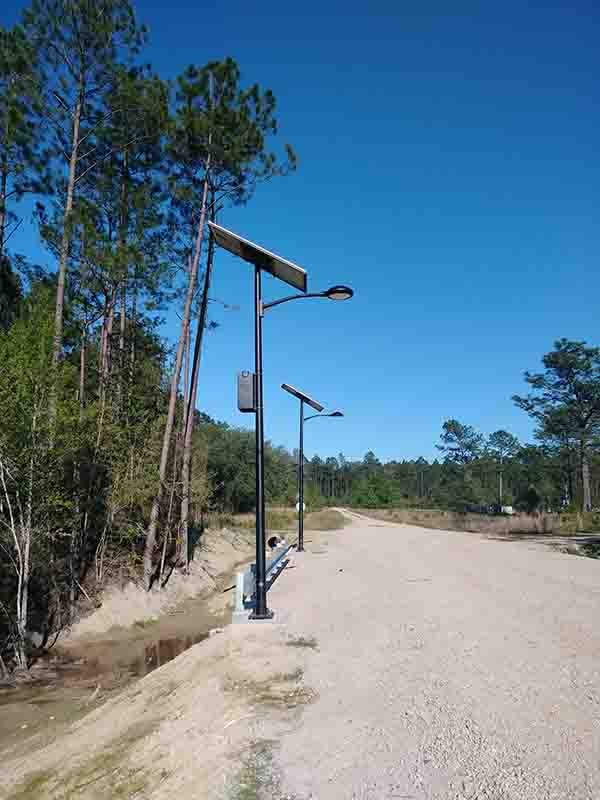
An LDR (Light-Dependent Resistor) is the sensor that lets a solar street light automatically turn on at dusk and off at dawn — no timer, no manual switching. It's a simple, reliable component that's been doing this job for decades, and it remains the standard in 2026 for dusk-to-dawn solar lights, often alongside more sophisticated motion sensors.
What an LDR actually is
An LDR is a resistor whose resistance changes based on the amount of light falling on it:
- Bright light — very low resistance (few hundred ohms)
- Darkness — very high resistance (megohms)
The controller in a solar light uses this resistance change to detect when ambient light has dropped below a threshold (dusk) and again when it rises above a threshold (dawn). At dusk, the controller switches the LED on; at dawn, it switches it off.
What LDRs do in a solar street light
1. Dusk detection (turn on)
As evening approaches and ambient light fades, the LDR's resistance rises. When it crosses a programmed threshold, the controller switches the LED on. Typical dusk activation is when ambient lux drops below 10-20 lux.
2. Dawn detection (turn off)
As sunrise approaches and ambient light increases, LDR resistance drops. When it crosses the dawn threshold (typically 30-50 lux), the controller switches the LED off.
3. Day mode (charging only)
During the day, the LDR reports bright light. The controller keeps the LED off and routes panel output to the battery for charging.
4. Cloudy / dusk override
If the day is very overcast, the LDR may report low light during what's technically daytime. Smart controllers include hysteresis (different thresholds for on vs off) to prevent the light from flickering on and off during marginal conditions.
LDR vs other dusk-to-dawn methods
LDR (most common)
Direct ambient light measurement. Reliable, cheap, mature. Used in nearly all modern solar street lights.
Panel voltage sensing
Some controllers detect dusk by monitoring the solar panel's open-circuit voltage. When panel output drops below a threshold, dusk is inferred. Works without a separate LDR sensor but less precise.
Real-time clock (RTC) timer
Some installations use a programmed clock-based on/off rather than light sensing. Rarely used in standalone solar street lights (drift over time is a problem) but common in scheduled commercial lighting.
Astronomical clock
RTC plus latitude/longitude calculation gives precise local dusk/dawn times year-round. Used in larger commercial installations with multiple fixtures, less common for individual standalone solar lights.
What changed in 2026 — combination with motion sensors
Modern solar street lights typically combine an LDR with a motion sensor:
- LDR determines whether it's dark enough to operate (day vs night)
- Motion sensor determines output level (full vs dimmed) when in night mode
This combination produces fixtures that automatically operate dusk-to-dawn at a dimmed baseline, ramp to full output when motion is detected, and return to dim after a hold period. The result: full battery efficiency through low-traffic hours, full brightness when needed. See motion sensors in solar street lights.
LDR placement and quality factors
- Sensor placement — must be exposed to ambient light, not blocked by housing or shading
- Dirt and water — LDR sensors fail or behave erratically when fouled. Quality fixtures include sealed LDR housings.
- False light sources — adjacent grid lights or shop signs can confuse cheap LDRs; quality controllers include some immunity
- Aging — LDRs slowly drift over years; high-quality components drift less
What can go wrong
- Light stays on during the day — usually a dirty or damaged LDR, or a controller fault
- Light fails to turn on at dusk — usually battery issue rather than LDR (LDR is failsafe in this direction)
- Light flickers at dusk/dawn — controller hysteresis settings, or LDR fouling
- Light triggered by adjacent lighting — LDR location issue or low-quality controller
LDR alternatives in indoor solar lighting
For indoor solar emergency lights and decorative fixtures, sometimes a simpler photodetector chip (rather than a discrete LDR component) is integrated into the controller. Functionally equivalent — same dusk-to-dawn behaviour.
What to verify when buying
- Dusk-to-dawn operation is automatic (no manual switch required)
- LDR or equivalent sensor is housed/sealed against weather
- Controller includes hysteresis to prevent flicker
- If combined with motion sensor, both work together correctly
Shinesun fixtures
Shinesun street lights ship with combined LDR + motion sensor operation as standard — automatic dusk-to-dawn with motion-activated brightness for maximum battery efficiency. For specific sensor specifications, see product pages or contact the team.