
Common Myths About Solar Street Lights in India (2026)
Shinesun's editorial team writes about solar lighting based on our manufacturing, installation, and field-service experience across India.
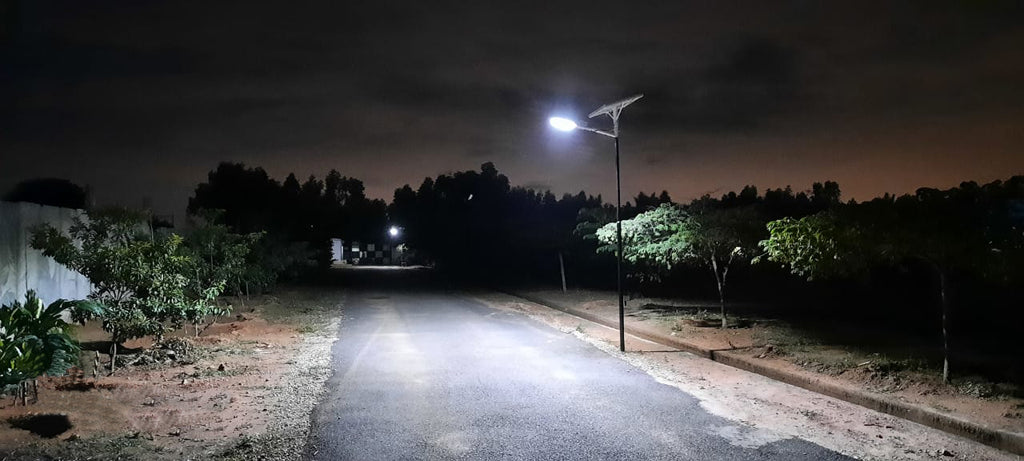
Solar street lights have come a long way since the early 2010s, but a lot of buyer hesitation still comes from outdated assumptions. Here are the eight most common myths, with the 2026 reality.
Myth 1: "Solar lights don't work during monsoon"
Reality: Properly sized fixtures have 2-3 days of battery autonomy, and even continuous cloud produces 20-40% of normal panel output. A 3-day-autonomy fixture handles even heavy monsoon zones. The "doesn't work in rain" reputation comes from cheap undersized fixtures, not from solar technology itself.
Myth 2: "Solar lights aren't bright enough for streets"
Reality: Modern LED packages deliver 130-160 lumens per watt — a 40W solar fixture matches the light output of a 100W+ conventional fixture from the 2000s. For wider main roads, 100W+ solar fixtures (like Shinesun's Nightjars series) deliver light comparable to high-output grid-powered alternatives.
Myth 3: "Solar lights are too expensive"
Reality: Higher upfront, lower lifetime cost. Once you factor in zero electricity bills, no trenching, no cabling, and no meter — solar typically pays back in 3-5 years and continues saving for the next decade.
Myth 4: "Solar batteries die in 2 years"
Reality: Lead-acid batteries do fade in 2-3 years — but LiFePO4 batteries (the 2026 standard for street lights) last 8-10 years. The myth comes from the 2010s when most cheap solar fixtures used lead-acid. Buy LiFePO4 and the battery is a multi-year non-issue.
Myth 5: "Solar lights need lots of maintenance"
Reality: Routine maintenance is essentially limited to panel cleaning every 2-3 months in dusty regions. No bulb changes (LED), no meter reading, no electricity bills, no inspection of buried cables. Genuinely lower-touch than conventional alternatives.
Myth 6: "All solar lights are the same"
Reality: Quality variance is enormous. The cheap-import end uses lead-acid batteries, undersized panels, no-name LED chips, and minimal weather sealing. A quality fixture from a real supplier with proper LiFePO4, sized panel, branded LED chips, and IP66 sealing is a fundamentally different product despite looking similar in photos.
Myth 7: "Solar street lights get stolen easily"
Reality: This was true of older split-design fixtures where the battery box mounted at ground level (lead-acid batteries had scrap value). Modern all-in-one designs put everything in a sealed unit at the pole top — no easy theft target.
Myth 8: "Solar lights only work in sunny states like Rajasthan"
Reality: Even the cloudiest Indian regions get adequate annual peak sun hours for properly sized solar fixtures. The difference is sizing: Rajasthan-spec fixtures can use a smaller panel and battery; Northeast-spec fixtures need oversized components for monsoon autonomy. The technology works across India — installation needs to match the region.
Where these myths come from
Most originate from genuine bad experiences with first-generation solar street lights in the late 2000s and early 2010s — when lead-acid batteries, low-efficiency LEDs, and undersized panels were the norm. The technology has changed significantly. The cheap end of the current market still produces fixtures that perpetuate these myths, which is why supplier selection matters as much as solar's reputation.
For a starting fixture that addresses all of the above (LiFePO4, properly sized panel, integrated design, motion sensor, IP66), see the Solar Bat 40W. For larger or site-specific requirements, talk to the Shinesun team.