
Solar Wall Lights: What 400 to 500 Lumens Actually Covers
Shinesun's editorial team writes about solar lighting based on our manufacturing, installation, and field-service experience across India.
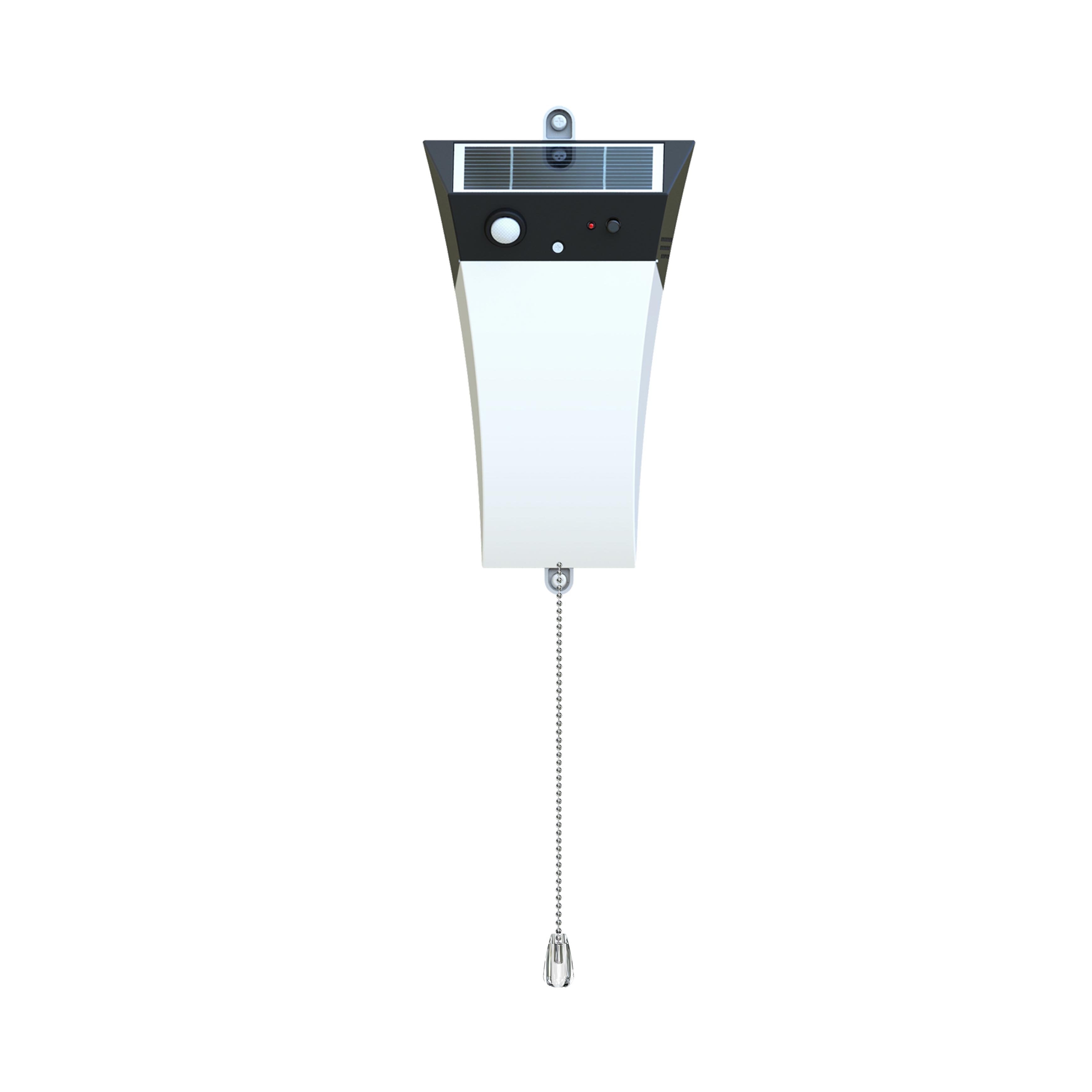
A solar wall light is a small fixture that gets asked to do one job well: light the few metres of ground in front of a door, a gate latch, a stairwell or a side passage. It is not a scaled-down street light, and most disappointment with the category comes from buying it as though it were.
This guide covers what the output figures on a wall light actually translate to on the ground, where to mount one, and — the part most buying guides skip — the positions where a wall light is the wrong product and something else should be specified instead. It is written to be useful whoever you buy from; Shinesun does not currently make a wall light, and the last section says what we would point you at instead.
What 400 to 500 lumens covers
Lumens measure total light leaving the fixture. Lux measures what lands on the ground. A wall light concentrates its output over a small area at close range, which is why a figure that sounds modest on paper is adequate in the position it is designed for.
Mounted at 2 to 2.5 m, a 400 to 500 lumen fixture will comfortably cover:
A doorway and the step or two in front of it.
Two to three metres of a side passage or a run of boundary wall.
A gate latch, so someone can find it and open it in the dark.
The turn at the top or bottom of an external staircase.
It will not light a driveway, a parking bay, an internal road or a garden of any size. Those need a fixture on a pole, and asking a wall light to do it produces a bright patch immediately below the fixture and darkness everywhere else. If that is the requirement, look at solar street lights instead — the smallest models in that range are sized for exactly this gap.
Warm white or 6000K: this is a real decision, not a finish
Colour temperature changes how a wall light performs more than most buyers expect, and it is the specification most often chosen as though it were a finish.
Warm white — around 3000K — suits a doorway, a porch or a seating area, anywhere a person stands close to the source. A cool white fixture at the same output reads as harsh at that distance.
Cool white — around 6000K — reads brighter than a warm source at the same lumen figure, which is why it suits security and utility positions: a back gate, a service passage, a compound corner, rather than a doorway you sit beside.
One more feature worth understanding: a rotatable head. On a fixed-head fixture the direction the light points and the direction the sensor watches are the same. At a corner, on a stairwell, or above a doorway set back from the mounting face, those two want to be different. A rotatable head lets you aim the light at the step while the sensor still covers the approach.
Mounting height and why sensor aim matters
Mount at 2 to 2.5 m. That range is not arbitrary:
Below 2 m the detection area shrinks and the light covers very little ground.
Above 2.5 m the sensor looks down at the ground rather than out along the approach, and triggers late — often after the person has already passed the thing they needed to see.
PIR sensors detect body heat moving across their field of view. Someone walking directly towards the sensor is detected noticeably later than someone crossing it. So aim the fixture across the approach rather than straight down it. A wall light at the end of a long straight path, pointing back along the path, is the single most common mounting mistake in this category.
Why the motion sensor is not a feature, it is the design
It is tempting to read a motion sensor as a convenience. On a solar wall light it is the reason the fixture works at all.
The fixture stays dim or off until movement is detected, then runs at full output for a hold period. That duty cycle is what allows a compact battery to cover a full night. A wall light running at full output continuously would need several times the capacity and cost several times as much — and would still be lighting an empty doorway for eleven hours.
This also means you cannot compare a motion-sensor fixture with a dusk-to-dawn one on battery size alone. They are answering different questions. If you want to understand the trade-off in more depth, our note on PIR lights and where they are used goes further into sensor behaviour.
The sun check that decides everything
On an integrated wall light the panel is part of the fixture. It charges from wherever the fixture is fixed — which means the wall face has to earn its position.
Before drilling, confirm the spot gets direct sun through the middle of the day. A north-facing wall in India, or a face shaded by an overhang, a neighbouring building or a tree, will underperform in every season. The monsoon does not create that problem; it just makes an existing one obvious.
This is the most common cause of a wall light "failing" in its first month, and it is not a fault. On a compact fixture there is no surplus panel area to absorb a poor position.
One further practical note: allow a full day of sun before judging the first night. These fixtures ship partly charged.
Installation
Two fixings. No wiring, no conduit, no earthing, no electrician, and no trench. That is the genuine advantage of the category over a mains wall light, particularly on a boundary wall or an outbuilding where running a cable would be the entire cost of the job.
What Shinesun currently makes
We no longer manufacture a solar wall light. The guidance above still holds for any fixture you are comparing, but so that nobody wastes time: our current range does not include one.
For the positions a wall light is usually bought for, these are the fixtures that do the job:
An entrance, gate post or boundary column — a solar gate or pillar light. The larger fixtures in that range light the approach rather than just marking it.
A driveway, parking area or any open ground — a pole-mounted solar street light. A wall light was never the right fixture for these anyway.
A path, garden or seating area — a solar garden or pathway light.
The full range is on the solar lights page.
Getting the choice right for your site
Every figure quoted above is the one on the product page it links to. If you are unsure which output a particular gate, wall or approach needs, send us the dimensions and a photograph of the position and we will tell you plainly — including when the answer is a fixture we do not make. Reach the team on +91 6364058660 or through the contact page.