
Monocrystalline vs Polycrystalline Solar Panels — 2026 Guide
Shinesun's editorial team writes about solar lighting based on our manufacturing, installation, and field-service experience across India.
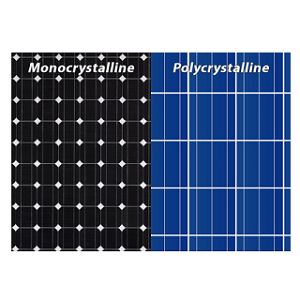
Monocrystalline and polycrystalline panels are the two dominant silicon technologies in 2026. Mono has won the high-efficiency end of the market; poly has largely been pushed to budget and entry-level fixtures. Here's the practical 2026 comparison.
What's actually different
Monocrystalline cells are cut from a single continuous silicon crystal grown by the Czochralski process. They're uniform black, the cells are typically octagonal-edged squares, and they convert sunlight more efficiently because the crystal structure has fewer defects.
Polycrystalline cells are cast from molten silicon that solidifies into many smaller crystals. They have a characteristic blue speckled appearance, simpler manufacturing, and slightly lower efficiency due to grain boundaries in the silicon.
2026 spec comparison
| Property | Monocrystalline | Polycrystalline |
|---|---|---|
| Module efficiency (commercial) | 20-23% | 16-18% |
| Cost per watt | ~10-15% higher | Lower |
| Performance in heat | Slightly better temperature coefficient | Slightly worse |
| Performance in low light | Better | Lower |
| Area required per watt | Less (more compact) | More |
| Lifespan | 25-30 years typical warranty | 20-25 years typical warranty |
| Appearance | Uniform black | Blue/speckled |
Why mono has won the premium market
As mono-cell manufacturing has scaled, the cost premium has shrunk to ~10-15% — small enough that for most applications the efficiency advantage justifies the cost. Specifically:
- Smaller panel for same wattage — important on solar street lights where the panel sits at the top of the pole and any size reduction helps wind loading and aesthetics.
- Better low-light performance — relevant for early-morning and late-evening charging, and for partly cloudy conditions.
- Better high-temperature behaviour — Indian summers push panel surface temperatures to 60-70°C, and mono cells lose less output per degree above 25°C.
- Longer warranties — most premium mono modules carry 25-30 year output warranties; poly typically 20-25.
What about TOPCon and HJT?
Mono and poly aren't the only cell technologies anymore. TOPCon (Tunnel Oxide Passivated Contact) is a refinement on monocrystalline that adds a thin oxide layer for better surface passivation — pushing commercial efficiency to 22-24% with lower temperature coefficients than standard mono. Through 2024 TOPCon overtook Mono-PERC as the production default at most large module makers, and by 2026 it dominates new utility-scale orders. HJT (heterojunction) is a smaller premium-end technology pushing 23-25% efficiency.
For solar street lights specifically, the distinction matters less than at utility scale — both TOPCon and standard mono are monocrystalline at their core, and the few percentage points of extra efficiency rarely justify the cost premium on a small fixture-mounted panel. For rooftop residential or utility-scale procurement in 2026, however, TOPCon is the modern default.
Where poly still fits
- Budget installations where total cost matters more than peak efficiency.
- Sites with abundant space where the larger panel area for poly isn't a problem.
- Hot regions with consistent strong sun where the efficiency gap is smallest in practice.
For solar street lights specifically
Mono is the default choice. The panel sits on top of the pole, so the smaller mono module is easier to mount and creates less wind load. The better low-light and high-temperature performance directly translates to more reliable charging in Indian conditions. The cost premium is small relative to the total fixture cost.
Shinesun's solar street lights use monocrystalline panels as standard, sized appropriately for the fixture wattage and Indian Peak Sun Hours. Browse the solar street light range or see the Solar Bat 40W for the most common residential and small-commercial use case.