
Solar Gate and Pillar Lights: Marking an Entrance or Lighting It
Shinesun's editorial team writes about solar lighting based on our manufacturing, installation, and field-service experience across India.
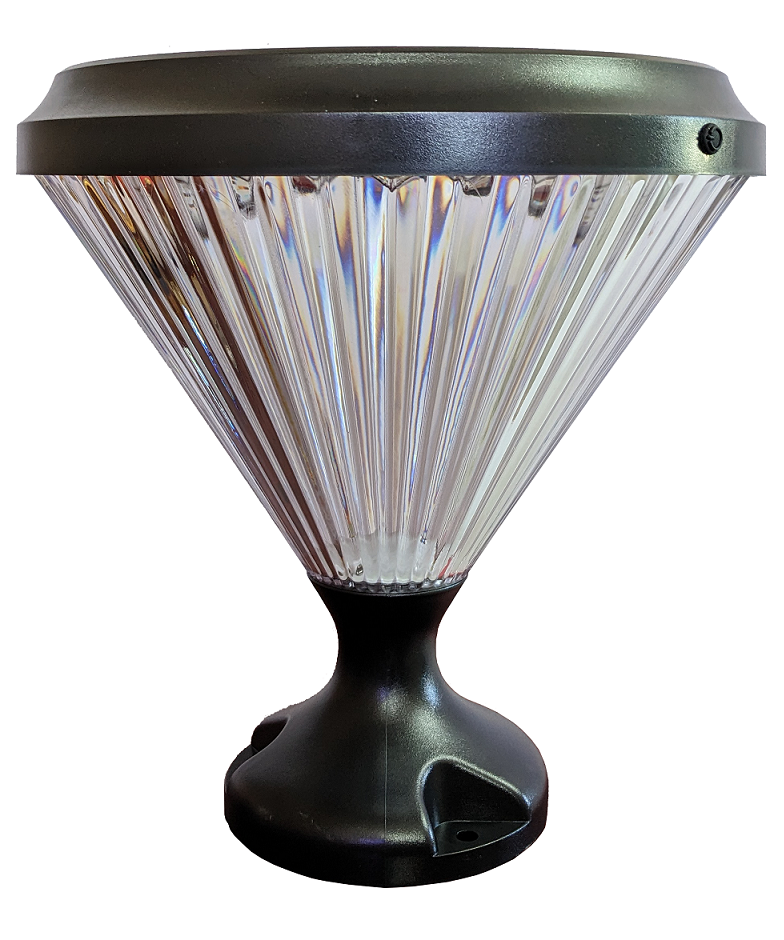
Solar gate and pillar lights are among the most confusing categories to shop, because a single label covers two genuinely different products. One is an accent fixture: it marks where your entrance is, adds a finished look to a pillar, and produces enough glow to be seen but not enough to light anything. The other produces real output and lights the approach to the gate.
Both are legitimate. Buying the first while expecting the second is the mistake, and price alone will not tell you which you are looking at.
Marking versus lighting: how to tell them apart
The lumen figure separates them, and the panel wattage confirms it. An accent pillar light typically runs on a 2 W panel and is designed to be looked at. An illuminating fixture needs a substantially larger panel and battery, because it is being asked to put usable light on the ground for the whole night.
Our own range spans both ends of this, which makes it a useful illustration:
The Volcano series gate and pillar light is an integrated fixture on a 2 W panel with an IP65 housing, in warm white. It marks a pillar handsomely and switches itself on at dusk.
The Opal TSOPL18W is an 18 W fixture producing 2,016 lumens on a 10 Ah LiFePO4 battery and a 6 W panel. At that output it lights the gate approach as well as marking it — which matters where a vehicle has to turn in after dark, or where a gate is set back from a road.
Roughly a fivefold difference in output sits between those two, and both are correctly described as pillar lights. Decide which job you need done before you compare prices.
One fixture or a pair
Gate pillars are almost always lit in pairs, one either side. This is not only symmetry. A single fixture on one pillar throws shadow across the opening from the other; two fixtures cancel each other's shadow and make the gap between them read as an opening rather than a dark slot. Budget for two from the start.
What IP65 means, and why it is the floor here
IP65 is dust-tight and protected against water jets from any direction. For anything mounted in the open in India, that is the practical minimum — not a premium feature.
A gate pillar is the most exposed position on a property. It takes direct monsoon rain with no overhang above it, it takes road dust year-round, and on a boundary wall it often takes the spray thrown up by passing vehicles. A fixture rated below IP65 in that position is a warranty claim waiting to happen.
Worth confirming the rating on any fixture you compare against ours, and worth being suspicious when it is not stated at all.
Battery chemistry: LiFePO4 and where lithium-ion is still the right answer
LiFePO4 is the current standard for outdoor solar lighting that has to run hard every night. It holds up thermally through Indian summers, carries a low fire risk, and gives a service life of 8 to 12 years. The Opal uses a 10 Ah LiFePO4 pack for exactly that reason — it is running an 18 W load from dusk to dawn.
Lithium-ion still has a legitimate place on compact accent fixtures like the Volcano, and it is worth being clear that this is a fit-for-use decision rather than a corner cut. A small gate light draws a fraction of the current, sits in a shallower duty cycle, and is often mounted where the thermal load is lower. Specifying LiFePO4 there would add cost and bulk to a fixture that does not need it.
What you should not accept at this price point is lead-acid, which gives 3 to 4 years at best. Our note on battery types used for solar storage covers the comparison in more detail.
Warm white at an entrance
Nearly every gate and pillar fixture worth having is warm white, and the reason is the viewing distance. An entrance is somewhere people stand, wait, and are greeted. A cool white source at close range reads as institutional — correct for a service yard, wrong for a front gate. Both the Volcano and the Opal are warm white for this reason.
The shading problem specific to pillars
Pillar tops sit lower than roofs and are frequently overhung by exactly the things people plant near entrances. Before fixing anything, stand at the pillar at midday and look up.
A pillar top shaded by a tree, a compound wall or a neighbouring structure will not charge properly, however bright the fixture is rated. On the Volcano's 2 W panel there is no margin at all for a poor position. Even on the Opal's 6 W panel, persistent partial shade through the middle of the day will show up as short runtime by the second half of the night.
Mounting itself is straightforward on both: they fix flat to a pillar top or column, switch automatically dusk to dawn, and need no wiring or mains connection.
The two ends of the range
| Fixture | Role | Notes |
|---|---|---|
| Opal TSOPL18W | Lights the approach | 18 W, 2,016 lumens, warm white, 6 W panel, 10 Ah LiFePO4 |
| Volcano series | Marks the pillar | Warm white, 2 W panel, lithium-ion, IP65 |
Full specifications and current pricing for all of them are on the solar gate lights page. If the requirement is to light a driveway or parking area beyond the gate rather than the entrance itself, that is a pole-mounted job — see solar street lights.
Getting the choice right for your site
Every figure quoted above is the one on the product page it links to. If you are unsure which output a particular gate, wall or approach needs, send us the dimensions and a photograph of the position and we will tell you plainly — including when the answer is a fixture we do not make. Reach the team on +91 6364058660 or through the contact page.