
How Do Solar Street Lights Work? — 2026 Explainer
Shinesun's editorial team writes about solar lighting based on our manufacturing, installation, and field-service experience across India.
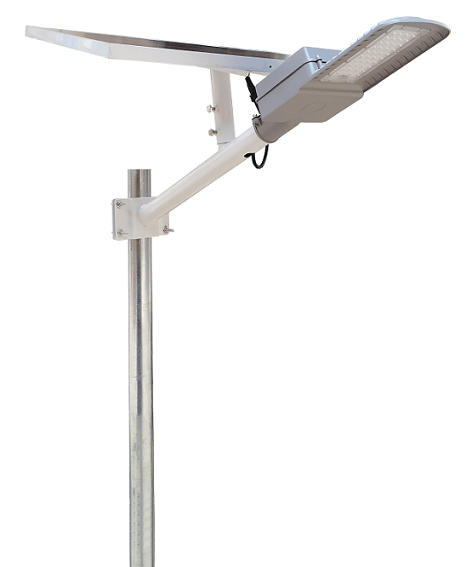
A solar street light is, at its core, a five-component system: a solar panel converts sunlight into DC electricity, a charge controller manages the flow, a battery stores it, an LED uses it to produce light at night, and a sensor decides when and how brightly to switch on. Here's how all five fit together in a 2026 fixture.
1. Solar panel — converts sunlight to electricity
The panel sits on top of the pole, typically angled 15-30° to capture optimal sunlight through the day. Inside, monocrystalline silicon cells absorb photons and release electrons, generating DC voltage. A 40W fixture typically pairs with an 80-120W panel — the panel must produce more energy per day than the LED consumes, with margin for cloudy days.
2. Charge controller — manages the flow
The controller sits between the panel and the battery. It does three jobs: it prevents the battery from overcharging (which damages cells), it stops it from discharging too deeply (which shortens lifespan), and it manages the day/night switching that turns the LED on at dusk. MPPT controllers (Maximum Power Point Tracking) extract 20-30% more energy from the panel than older PWM designs, particularly in cloudy or off-peak conditions.
3. Battery — stores energy for nighttime use
The battery is the heart of the system. Modern fixtures use LiFePO4 (lithium iron phosphate) cells because they tolerate Indian summer heat, have very low fire risk, and last 8-10 years. Older designs used lead-acid or Li-Ion; both are still in some compact applications, but LiFePO4 has become the standard for street lights. See why LiFePO4 beats Li-Ion for the full comparison.
4. LED — produces the light
Modern LED packages deliver 130-160 lumens per watt — far more efficient than the sodium or fluorescent lamps that previous-generation street lights used. The LED draws power directly from the battery through the controller. A 40W LED running 10 hours consumes about 400Wh — well within the storage capacity of a properly-sized LiFePO4 battery.
5. Sensor — decides when and how brightly to switch on
Most modern fixtures include a motion sensor (PIR or microwave) that ramps the LED to full brightness when movement is detected and dims to ~30% when nothing's around. This effectively doubles useful battery hours and extends the night the fixture can illuminate. Intelligent sensors add gradual evening dimming for streets where some lighting is needed all night.
The day-and-night cycle
- Sunrise to ~5pm — panel charges battery, LED is off.
- Dusk — controller detects low light, switches LED on.
- Through the night — battery powers LED at full brightness when motion is detected, dim otherwise.
- Dawn — controller switches LED off, charging cycle resumes.
For a typical 40W fixture in Indian conditions, this cycle repeats reliably for 8-10 years before the battery needs replacement, with routine maintenance limited to panel cleaning every few months.
To see how the components are sized and selected, read how to design a solar LED street light system. For a starting fixture, the Solar Bat 40W packages all of the above into a single integrated unit.