
Best Solar Flood Lights in India (2026)
Shinesun's editorial team writes about solar lighting based on our manufacturing, installation, and field-service experience across India.
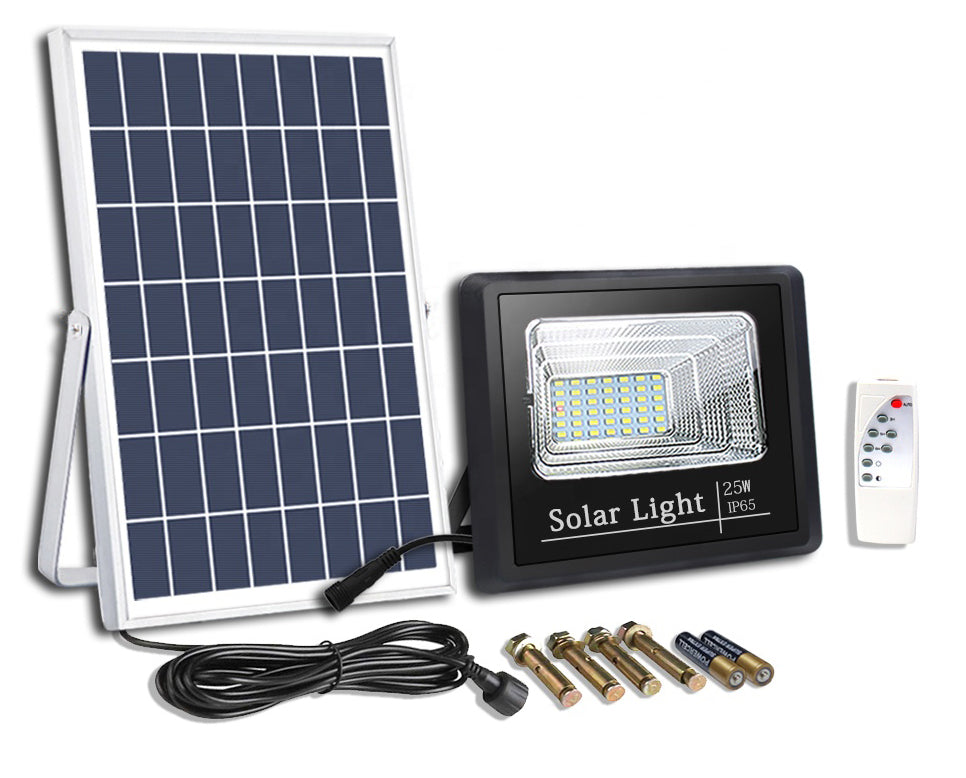
Solar flood lights are one of the highest-value categories in solar lighting — instant security, no wiring, no electricity bill, motion-triggered when you need full brightness. In 2026, quality solar flood lights have caught up with grid-powered alternatives in light output and reliability. Here's how to pick one for your installation.
What a solar flood light is for
Flood lights produce a wide beam of high-intensity light, typically aimed downward to cover a defined area. The classic uses:
- Security — backyards, side passages, driveways, equipment storage. Motion-triggered for energy efficiency and deterrence.
- Area lighting — parking, courtyards, work zones. Constant-on or dusk-to-dawn for general visibility.
- Sports / event lighting — courts, fields, gatherings. High output on demand.
- Industrial / commercial — yards, perimeters, loading bays. Continuous or motion-activated.
Wattage / lumen guide by application
- Small residential security (driveways, gates) — 500-1500 lumens (10-20W)
- Medium residential security (back gardens, side passages) — 1500-3000 lumens (20-30W)
- Commercial / large residential — 3000-6000 lumens (40-60W)
- Industrial yards, parking — 6000-12000+ lumens (60-100W+)
- Sports / event lighting — 10000+ lumens, often multiple fixtures
Motion sensor: standard, not optional
For security applications, motion sensor is the entire point. A 60W flood light constant-on through the night burns through battery; the same fixture motion-triggered runs for 3-5 years on a single charge cycle.
- PIR sensors — 6-12m detection range, low cost, mature technology
- Microwave radar sensors — 10-15m range, works through some obstacles, higher cost
- Dual sensors (PIR + microwave) — both must trigger; minimal false triggers
Match sensor range to mounting height: a 6m mount needs at least 8m sensor range to be useful.
Build quality essentials
IP rating — IP66 minimum for outdoor
Flood lights mount in the open, full monsoon exposure. IP65 is the absolute minimum; IP66 is what to specify. See IP ratings explained.
Battery — LiFePO4 for longevity
Solar flood lights see heavy battery cycling (charge by day, discharge on every trigger). LiFePO4 handles this cycle load far better than Li-Ion or lead-acid. See lithium-ion vs LiFePO4.
Panel sizing
For flood lights, the 2-3× LED wattage rule is even more important — flood lights consume more power per cycle than constant-low-output street lights. Quality flood lights have proportionally larger panels.
Housing material
Die-cast aluminium with powder coating lasts decades. ABS plastic discolours and cracks in Indian sun within a few years.
Mounting flexibility
Look for adjustable mounting brackets — the right aim angle is what determines actual coverage. Fixed-angle mounts limit installation flexibility.
Common solar flood light mistakes
- Buying highest wattage available — a 200W security flood for a small backyard is overkill, and overlights neighbours
- No motion sensor — burns through battery, defeats the value proposition
- Wrong colour temperature — cool white (5000-6000K) for security, warm white (3000K) for ambient/decorative
- Poor mounting — aimed wrong direction, lights up the wall instead of the area
- Budget fixtures in heavy-use applications — security fixtures get heavy cycling; cheap battery dies in months
Installation considerations
- Mounting height — typically 2.5-4m for residential security; higher for commercial area coverage
- Aim angle — point downward at 30-45° from vertical for ground coverage; minor adjustments dramatically change coverage
- Panel orientation — for separate-panel fixtures, ensure panel faces south and isn't shaded by trees or buildings
- Sensor range and arc — verify the lit area is within sensor coverage
What to verify before buying
- LiFePO4 battery
- IP66 die-cast aluminium housing
- Motion sensor (PIR or microwave) with disclosed detection range
- Lumens output specified at rated wattage
- Adjustable mounting bracket
- Panel-to-LED wattage ratio at 2-3× minimum
- Documented warranty
Shinesun solar flood lights
Shinesun's flood light range covers 10W to 100W+ output, with LiFePO4 batteries, IP66 housings, and motion sensors as standard. Browse the solar flood lights collection, or contact the team for site-specific recommendations.