
What Should I Look For When Buying Solar Lights? (2026)
Shinesun's editorial team writes about solar lighting based on our manufacturing, installation, and field-service experience across India.
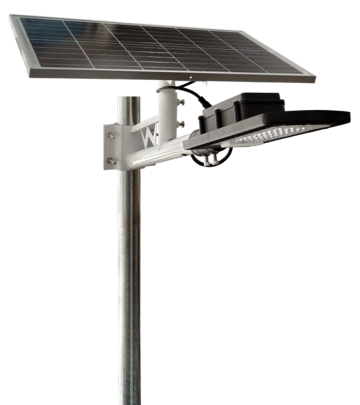
Solar lights come with marketing claims about lumens, efficiency, smart sensors, and IP ratings that can make comparison hard. Here are the eight specifications that actually matter in 2026 — and the claims you can safely ignore.
1. Battery chemistry (the single most important spec)
Insist on LiFePO4 for any outdoor fixture intended to last. Li-Ion is acceptable for small compact fixtures like gate lights. Lead-acid means 3-4 year replacement cycles. See battery types compared.
2. Panel wattage relative to LED wattage
Rule of thumb: panel wattage should be 2-3× LED wattage. A 40W fixture needs an 80-120W panel. Lower ratios are the most common reason cheap fixtures fade after a season or two.
3. Battery capacity and autonomy
Ask: "how many days of autonomy is this rated for?" Answer should be at least 2 days for most of India, 3+ for monsoon regions. See rainy day performance.
4. IP rating
IP65 is the minimum for outdoor use. IP66 for coastal or heavy-monsoon regions. Below IP65 is for sheltered installations only.
5. LED type and lumens per watt
Modern LED packages deliver 130-160 lm/W. Below 120 lm/W suggests older or low-quality LED chips. The actual lumen output (not just wattage) determines brightness — a quality 40W fixture can outperform a cheap 60W.
6. Sensor type and behaviour
Motion sensors (PIR or microwave) dramatically extend useful battery hours. Verify the dim-state brightness (~30% is typical) and the ramp-up speed. Intelligent sensors add scheduled dimming through the night.
7. Mounting and pole compatibility
Check the mounting interface matches your pole. Pole heights affect lit area and wattage requirements — see how to choose.
8. Warranty and supplier support
Quality fixtures typically carry 5+ year warranties on the panel, 2+ years on the battery (with 8-10 year expected life for LiFePO4), and 2+ years on the LED driver. Cheap-import fixtures often have no real warranty or no supplier presence to claim it.
Claims you can safely ignore
- "Smart" / "AI" / "IoT" features on basic fixtures — usually marketing fluff; standard motion sensor is what you actually need.
- Wildly inflated wattage claims — some imports list "120W" when the actual LED is 30W. Look for actual lumen output.
- "Solar panel efficiency 25%+" — possible but only on cutting-edge premium modules. Anything over 23% on a budget fixture is a marketing exaggeration.
- "15-year battery" claims for lead-acid or generic lithium — physically not credible. LiFePO4 realistically lasts 8-10 years; nothing else comes close.
- "Industrial grade" / "military spec" without specific certification numbers — meaningless marketing terms.
For a starting fixture meeting all eight specs above, see the Solar Bat 40W. For specific requirements or larger fixtures, contact the team.