
Automatic Solar Lights — How They Work and What to Look For (2026)
Shinesun's editorial team writes about solar lighting based on our manufacturing, installation, and field-service experience across India.
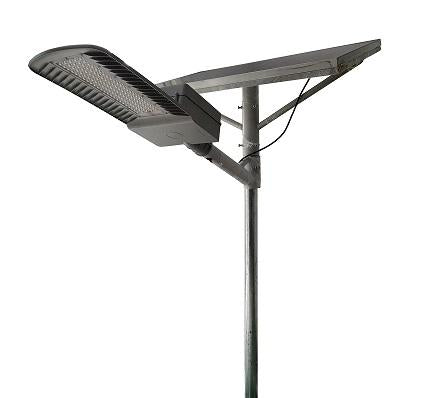
"Automatic" is one of the headline features of modern solar lights — and one of the most genuinely useful. A 2026 quality fixture turns on at dusk, runs through the night with motion-sensored brightness, and turns off at dawn — all without manual intervention or scheduled timers. Here's how this works and what to look for.
What "automatic" actually means in a solar fixture
Modern solar fixtures combine several automatic behaviours:
- Automatic dusk-to-dawn — LDR sensor detects ambient light; controller switches LED on at dusk, off at dawn
- Automatic motion response — PIR or microwave sensor detects movement; controller ramps LED to full output, holds, then ramps back to baseline
- Automatic scheduled dimming — controller dims output during low-traffic hours (e.g., midnight to 4am at 30% baseline)
- Automatic battery management — controller protects battery from over-charge, over-discharge, and over-temperature
- Automatic compensation for marginal weather — controller may reduce LED output during extended cloudy periods to preserve battery
None of this requires user intervention or scheduled timer setting.
How the dusk-to-dawn part works
An LDR (light-dependent resistor) on the fixture detects ambient light:
- Day — bright light, low LDR resistance, controller keeps LED off and charges battery
- Dusk — ambient light drops below threshold (typically 10-20 lux), controller switches LED on
- Night — fixture operates in its programmed mode
- Dawn — ambient light rises above threshold (typically 30-50 lux), controller switches LED off
The LDR includes hysteresis so the fixture doesn't flicker on and off during marginal dusk/dawn conditions. See LDR in automatic lights.
How the motion response works
Once the fixture is in night mode (dusk to dawn), the motion sensor monitors for movement:
- Idle — fixture runs at baseline (typically 20-30% output) or off
- Detection — sensor triggers; controller ramps LED to full output near-instantly
- Hold — fixture stays at full output for typically 30-60 seconds after last detection
- Return — fixture ramps back to baseline
This pattern extends battery life dramatically while keeping the fixture available at full brightness when needed. See motion sensors in solar street lights.
How scheduled dimming works
Smart controllers can vary the night-mode behaviour based on time:
- Dusk to 10pm — full output (peak activity hours)
- 10pm to midnight — 70% baseline with motion response
- Midnight to 4am — 30% baseline with motion response
- 4am to dawn — 50% baseline with motion response
Tuning this to your specific traffic pattern further extends battery hours. Most fixtures ship with a sensible default; some allow user adjustment.
What automatic behaviour requires from the fixture
Quality sensor placement
The LDR must be exposed to ambient light; the motion sensor must have clear sight to the ground area. Cheap fixtures with poorly positioned sensors trigger erratically or miss detections.
Intelligent controller logic
The microcontroller running the operating logic determines how smart the fixture is. Quality controllers handle hysteresis, scheduled dimming, fault recovery, and battery protection seamlessly.
Sufficient battery capacity
Automatic dim-state operation still consumes power. Adequate battery sizing is what makes all-night operation possible.
Properly sized panel
Automatic charging through the day depends on adequate panel sizing. Undersized panels can't keep up with night-time consumption.
What can go wrong with automatic operation
Fixture stays on during the day
Usually a dirty or damaged LDR, or controller fault. Clean the LDR window first.
Fixture fails to turn on at dusk
Usually a battery issue rather than LDR (the controller still detects dusk but can't drive the LED). Check battery health.
Fixture triggers constantly through the night
Motion sensor mis-positioned, set too sensitive, or false-triggering on wind/animals. Adjust sensitivity if available; reposition sensor if not.
Fixture doesn't ramp up on motion
Sensor failure, controller fault, or sensor blocked by debris. Clean sensor first; if persistent, service required.
Fixture too dim through the night
Battery depletion, undersized panel, or aggressive scheduled dimming. Verify panel cleaning first; if persistent, may indicate degraded battery.
Comparing to non-automatic alternatives
Manual switch fixtures
Some budget fixtures have on/off switches with no automation. Useless for outdoor street lighting — you can't manually switch a pole-top fixture at dusk every night.
Timer-based fixtures
Older designs sometimes use RTC timers. Problems: clock drift over months, no adjustment for seasonal day-length changes, no motion response. Largely obsolete in 2026.
Photocell-only fixtures
Older budget fixtures sometimes have only a photocell (LDR) and no motion sensor. They turn on at dusk and stay on at full output all night. Battery-inefficient compared to motion-sensored fixtures.
Full automatic (LDR + motion + smart dimming)
The 2026 standard for quality fixtures. Maximum battery efficiency, optimal lighting when needed.
What to verify before buying
- LDR (or equivalent ambient light sensor) for automatic dusk-to-dawn
- Motion sensor type (PIR / microwave / dual)
- Disclosed motion sensor detection range
- Documented scheduled dimming behaviour or user adjustability
- Hold time after detection (30-60 seconds typical)
- Battery protection (low-voltage cutoff, over-voltage protection)
- Smooth dimming transitions (not abrupt on/off)
Customising automatic behaviour
Some premium fixtures allow user adjustment of:
- Dim-state baseline brightness
- Hold time after motion detection
- Scheduled dimming start times
- Sensor sensitivity
For most installations, factory defaults work well. Adjustment becomes useful for specific applications like high-traffic main roads, dark security zones, or quiet residential streets.
The economic case for automatic operation
A 40W automatic motion-sensored fixture delivers the equivalent functional lighting of a 60W continuous-on fixture while consuming significantly less battery. That allows:
- Smaller battery capacity for the same lit hours
- Smaller panel for the same battery cycling
- Lower overall fixture cost for the same practical output
- Extended battery lifespan (less daily cycling depth)
This is why "automatic" isn't just convenience — it's a meaningful design optimisation that has shaped the entire 2026 fixture category.
Shinesun's automatic fixtures
Shinesun's solar street lights include automatic dusk-to-dawn LDR sensors, motion sensors (PIR or microwave depending on model), and scheduled dimming as standard. For specific automatic behaviour or sensor type questions, see product pages or contact the team.