
How Long Do Solar Street Lights Work on Rainy Days? (2026)
Shinesun's editorial team writes about solar lighting based on our manufacturing, installation, and field-service experience across India.
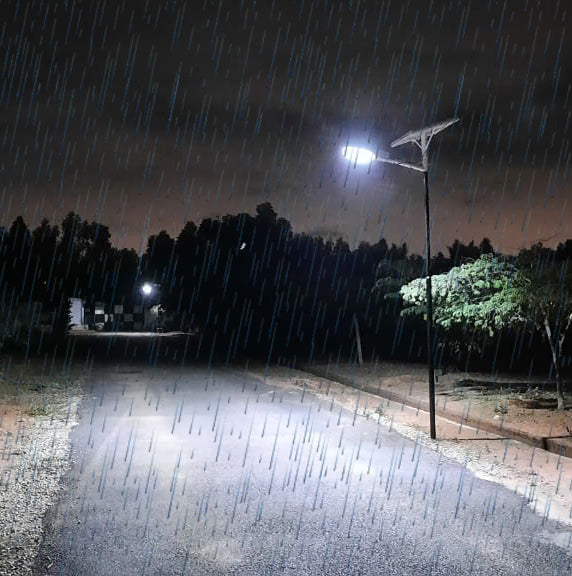
The Indian monsoon raises a fair concern: if a solar street light depends on sunlight, what happens during a week of solid rain? The honest answer is that a properly designed system handles 2-3 consecutive cloudy days without issue, and a fixture designed for monsoon regions handles 4-5 days. Here's how the math works and what to specify for high-rain areas.
The autonomy concept
Autonomy is the number of days a solar light can keep running on stored battery energy without any new charging. It's a deliberate design choice — bigger battery and panel = more autonomy = higher cost.
- 1 day autonomy — cheapest, fine for very sunny regions where consecutive cloudy days are rare
- 2 days autonomy — typical mid-range design, suitable for most of India
- 3 days autonomy — standard for monsoon-region fixtures (Konkan, Northeast)
- 4-5 days autonomy — high-monsoon specification (some Northeast and Western Ghats locations)
What happens during a cloudy stretch
- Day 1 cloudy — panel still generates 20-40% of normal output even under thick cloud. Combined with the previous day's full charge, the fixture runs normally.
- Day 2 cloudy — battery starts noticeably draining. A motion-sensor fixture dims earlier or for longer periods to conserve.
- Day 3+ continuous heavy cloud — well-designed monsoon fixtures still operate; basic designs may shut off mid-night to preserve battery.
- Sunlight returns — battery recharges over the next 1-3 sunny days, full operation resumes.
Specifying for monsoon regions
If you're installing in Kerala, Goa, Konkan coast, Assam, or any region with multi-day monsoon stretches, ask your supplier specifically about:
- Autonomy days — should be 3+ minimum, ideally 4-5 for the heaviest monsoon zones
- Panel oversize factor — typically 1.5-2× normal to ensure recharge during partly-cloudy days between rain
- IP rating — IP66 minimum for monsoon exposure
- Battery sizing — LiFePO4 with capacity matched to autonomy × daily load
Common failure mode: undersized cheap fixtures
The most common complaint about "solar lights not working in rainy season" comes from undersized cheap fixtures — typically 1-day-autonomy designs sold across regions regardless of climate. They work fine on sunny days, struggle as soon as cloud cover extends past one night, and earn solar lighting a bad reputation it doesn't deserve.
The fix isn't to abandon solar; it's to specify the right autonomy for your region.
Real-world expectation
A 2-day-autonomy fixture in most of central India will get through a normal monsoon without interruption — the cloudy stretches rarely exceed 2 consecutive days. A 3-day-autonomy fixture handles the heavier monsoon zones. A 4-5 day specification covers the worst cases.
For Shinesun's mid-range fixtures like the Solar Bat 40W, the standard sizing is 2-day autonomy, suitable for most of India. For high-monsoon regions or specific autonomy requirements, contact the team with your location and we'll specify accordingly.