
Why Choose Solar Lights for Pathways (2026)
Shinesun's editorial team writes about solar lighting based on our manufacturing, installation, and field-service experience across India.
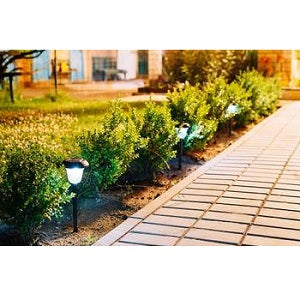
Pathways — garden paths, walkways through compounds, paths between buildings — are exactly the use case where solar lighting excels. They don't need the high output of street lighting, they often run through landscaped areas where trenching is impractical, and they benefit from the low-output ambient illumination solar fixtures naturally provide. Here's why solar is the right answer for pathway lighting in 2026.
What pathway lighting needs to do
Good pathway lighting balances several goals:
- Safety — illuminate the walking surface, prevent trips and falls
- Direction — define the path so people stay on it
- Atmosphere — contribute to ambient quality, not feel like a parking lot
- Security — provide visibility for residents and deter intrusion
- Aesthetic — integrate with the landscape design
This is a moderate-output, distributed-fixture, atmosphere-mattering scenario — almost the textbook case for solar.
Why solar fits pathways naturally
1. Installation simplicity
Most pathway fixtures install in under an hour with no trenching, no cabling. Stake lights push into garden soil; wall fixtures bolt to a fence or compound wall. Compare to grid-tied which often needs new buried conduit along the entire path length.
2. Lower output requirement
Path lights need 50-200 lumens each — easily achievable by small solar fixtures with modest panels and batteries. The economics of solar work strongly at this output level.
3. Distributed pattern
Multiple small fixtures every 1.5-2m along a path. With grid, each fixture is another wiring node. With solar, each fixture is independent.
4. Landscaping compatibility
No buried cables means landscape planting, replanting, mulching, even excavating for irrigation can happen without electrical hazards or rewiring.
5. Safety from low voltage
Pathway fixtures are exposed to people, pets, garden tools, water from irrigation. Solar fixtures operate at 12V (or lower); grid fixtures at 230V. The shock hazard is fundamentally different.
6. Atmosphere-friendly
Modern solar pathway fixtures with warm-white LEDs and motion sensors produce exactly the kind of ambient atmosphere gardens need. Bright continuous fluorescent isn't what a residential path wants.
Pathway fixture types and selection
Stake / bollard lights (most common)
Small fixtures pushed into garden soil along the path edge. Typical specs:
- 50-150 lumens each
- Warm white (3000K) preferred for residential
- 30-50cm height typical
- Internal battery (often NiMH AA for budget, Li-Ion for quality)
- Solar panel integrated into the top
Wall-mounted path lights
Used where the path runs along a wall (e.g., compound boundary, garden retaining wall). Higher output than stake lights, longer life-cycle battery:
- 150-400 lumens
- Warm or neutral white
- Li-Ion or LiFePO4 batteries
- Motion sensor often included
Pole-mounted pathway lights (longer paths)
For paths longer than ~50m, or paths between buildings, a small pole-mounted fixture every 15-20m may make more sense than dozens of stake lights:
- 3-4m pole
- 12-20W LED, 1000-2500 lumens
- LiFePO4 battery
- Motion sensor with dim baseline
Step lights
For stepped paths, dedicated step lights integrated into wall faces illuminate individual steps without glare. Small, focused, often warm-white.
How many fixtures and what spacing
- Stake lights along narrow garden path — every 1.5-2m
- Wall lights along compound path — every 3-4m
- Pole lights along driveway/longer path — every 15-25m
- Step lights — every 3-4 steps
Tighter spacing for safety-critical or low-light atmospheric reasons; wider spacing where ambient lighting from adjacent buildings provides supplement.
Common pathway lighting mistakes
- Over-lighting — buying floor-light wattage for a residential garden path
- Wrong colour temperature — cool white feels institutional; warm white feels residential
- Insufficient sun exposure on stakes — under tree canopy or close to walls, stake lights underperform
- Cheap fixtures with weak panels — fade after 1-2 seasons
- No motion sensor — useful for distributed pathway fixtures, especially security applications
What to specify for quality pathway lighting
- Warm white (3000K) LED for residential garden paths; neutral or cool for safety-critical or commercial
- Li-Ion or LiFePO4 battery (avoid NiMH AA for fixtures meant to last more than 1-2 years)
- IP65 minimum (these fixtures get rained on)
- Panel sized 2-3× LED wattage
- Motion sensor where appropriate (security paths; not decorative ambient)
- Tested in monsoon conditions (look for reviews from comparable regions)
Pathway lighting layout — a quick example
For a 30m garden path from gate to door:
- Gate light at the entrance (medium output, mixed warm/cool)
- 15 stake lights at 2m spacing along the path edge (150 lumens each, warm white)
- Wall light at the door (medium output, motion-triggered)
- Optional: motion flood light at any dark side of the path
Total install time for a competent DIYer: 2-3 hours. Total cost: ₹8,000-15,000 for quality fixtures. Annual electricity cost: zero. See best solar garden lights.
Shinesun pathway lighting
Shinesun supplies a range suited to pathway lighting — solar gate lights, garden wall lights, garden pole lights, and motion flood lights. Browse the solar garden lights collection or contact the team for specific pathway layout recommendations.