
What are PIR Lights and Where They Are Used (2026)
Shinesun's editorial team writes about solar lighting based on our manufacturing, installation, and field-service experience across India.
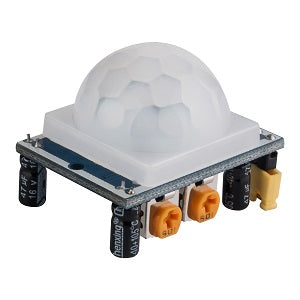
PIR (Passive Infrared) sensors are the most common type of motion sensor in solar lights — and the one you're most likely to see in budget through mid-range fixtures. They're cheap, reliable, and well-understood. Here's how they work, where they fit best, and how they compare to alternatives in 2026.
How PIR sensors work
Everything warmer than absolute zero emits infrared radiation. A PIR sensor consists of two infrared-sensitive elements arranged to detect changes in IR levels across their field of view. When something warm (a person, animal, vehicle) moves across the sensor's view, the two elements register different IR levels in sequence — and the sensor triggers.
Key properties:
- Passive — sensor doesn't emit anything; it only receives ambient IR. Hence the "passive" in PIR.
- Motion-triggered — detects movement, not static presence. A still object cools or heats the field gradually and won't trigger.
- Cone of detection — typically a 90-120° angle, range 4-8m for typical sensors.
PIR sensors in solar lighting
In a solar street light or solar flood light, the PIR sensor triggers a state change:
- Idle (no detection) — fixture is dim (typically 20-30% output) or off
- Triggered — fixture ramps to full output
- Hold — typically 30-60 seconds at full output after last detection
- Return to idle — ramps back to dim/off after hold expires
This pattern can double useful battery hours compared to constant-on operation. See motion sensors in solar street lights.
Where PIR is the right choice
- Residential security lights — driveways, side passages, backyards (4-8m detection sufficient)
- Gate lights — short detection range (1-3m for approaching visitors)
- Pathway lighting — sensors trigger on people walking the path
- Garden flood lights — short-range area lighting
- Compound corner lighting — perimeter areas with intermittent occupancy
- Low-traffic residential streets — pedestrians, vehicles, animals trigger reliably
Where PIR doesn't work well
- Higher mount or longer range — above ~8-9m mounting, PIR coverage thins
- Hot ambient conditions — when ambient temperature is close to body temperature (above 40°C), PIR contrast reduces
- Through any obstacle — PIR needs line of sight to the heat source
- Direct sunlight on sensor — can saturate or confuse the sensor
- Wide open commercial yards — coverage gaps at long distances
PIR vs microwave radar — what differs
| Property | PIR | Microwave |
|---|---|---|
| Detection range | 4-8m | 8-15m |
| Cost | Lower | Higher |
| Hot ambient | Reduced sensitivity | Unaffected |
| Detects through | Line of sight only | Light foliage, thin walls |
| False trigger | Heated objects, animals | Vehicles passing, wind-driven trees |
| Mature technology | Yes | Yes, but newer in solar lighting |
| Power draw | Very low | Slightly higher |
The right sensor depends on the installation. PIR for short-range, well-defined detection zones; microwave for longer-range, wider-coverage applications.
What changes in 2026
- Sensor combination — premium fixtures combine PIR with microwave for low false-trigger detection
- Integration with LDR — sensors run only after dusk, conserving battery during the day
- Smart hold times — adaptive timing based on detection patterns (more detections → longer hold)
- Adjustable sensitivity — fixed-sensitivity PIR sensors are common in budget fixtures; quality units have adjustable settings
PIR sensor maintenance
- Keep the lens clean — dust on the sensor lens reduces sensitivity; quick wipe twice a year
- Avoid relocation — sensors are typically calibrated for the original installation position
- Replace ageing sensors — sensors gradually lose sensitivity over 8-10 years
Common PIR fixture problems
- False triggering on hot windy nights — wind-blown warm objects (curtains, leaves close to lens) trigger sensor. Repositioning often fixes.
- Missed triggers in summer — high ambient temp reduces contrast. Sensitivity adjustment can help.
- Pet triggers — dogs, cats, even rats can trigger residential security lights. Adjust sensor angle to point away from ground if undesirable.
- Sensor stuck "always on" — usually a fault in the sensor or its driver. Replace.
Shinesun PIR-equipped fixtures
Shinesun's residential and mid-range fixtures include PIR sensors as standard with adjustable sensitivity. Premium commercial fixtures combine PIR with microwave radar for low false-trigger high-range detection. For specific sensor specifications, see product datasheets or contact the team.