
Things to Consider Before Installing a Solar Street Light (2026)
Shinesun's editorial team writes about solar lighting based on our manufacturing, installation, and field-service experience across India.
The fixture you buy is only half the equation. The other half is how the site, climate, and use case align with what the fixture is designed for. Here's the checklist to run through before you install a solar street light, whether for a home compound, a society, or a commercial site.
1. Verify sun access
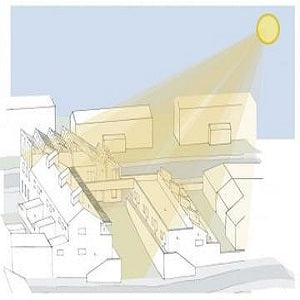
The panel needs unobstructed sunlight for most of the day to charge reliably. Walk the site at 10am, noon, and 3pm. If trees, buildings, or other structures shade the panel for more than 1-2 hours total, expect reduced charging — either oversize the panel or pick a different mounting location. South-facing orientation is best in India; east/west is workable but less optimal.
2. Pick the right pole height
Pole height drives the lit area and the wattage you need:
- 3-4m → small areas, residential gates, paths → 12-20W
- 6-8m → driveways, parking, internal roads → 30-60W (the Solar Bat 40W sweet spot)
- 9m+ → main roads, highways → 75-150W
3. Match wattage to actual need
Don't over-spec. A higher wattage means a larger panel, a heavier battery, and a more expensive fixture. Wattage that exceeds your real lighting need just wastes money and adds weight to the pole.
4. Check the soil and pole foundation
Solar poles are typically heavier than conventional grid-fixture poles (the panel adds weight and wind loading). A proper concrete foundation 0.6-1.2m deep, sized for the pole and panel surface area, is non-negotiable. In coastal or termite-prone areas, specify galvanised hardware and termite-resistant treatment.
5. Climate-specific selection
- Hot regions (Rajasthan, Gujarat, MP) → LiFePO4 battery non-negotiable; Li-Ion fades fast at sustained pole temperatures.
- Coastal/humid (Kerala, Goa, coastal AP) → IP66+ rating, corrosion-resistant frame, hot-dip galvanised pole.
- High-monsoon/cloud (Northeast, Konkan) → oversize panel and battery for extended cloudy windows; 3-day autonomy minimum.
- Cold/high-altitude (Ladakh, Himachal hills) → verify low-temperature charging behaviour.
6. Security and theft considerations
All-in-one fixtures (panel, battery, LED all in one sealed unit at the pole top) are much more theft-resistant than split designs with a battery box on the pole. For roadside or public installations, the integrated design is the safer default.
7. Sensor type for the use case
- Residential, gardens, low-traffic → motion sensor (saves battery)
- Streets, parking, public areas → intelligent sensor (some light all night with motion override)
- Critical security with constant high output → fewer sensor options; expect shorter battery life
8. Plan for maintenance access
Panels need cleaning every few months in dusty regions. Even sealed fixtures eventually need battery replacement (~8-10 years for LiFePO4). Choose mounting that allows safe panel access without a crane wherever possible.
9. Buy from a supplier who'll be around for support
The cheap-import end of the market is filled with no-name fixtures, no warranty, and no service. The cost difference between a fixture with proper warranty and a no-warranty knock-off is small; the cost of replacing a failed knock-off installation is large.
If you've worked through this checklist and need help on selection, contact the Shinesun team with your site details (pole height, area to be lit, climate, sun access) and we'll size the right fixture for the site.