
Solar Street Lights vs Conventional Street Lights — 2026 Comparison
Shinesun's editorial team writes about solar lighting based on our manufacturing, installation, and field-service experience across India.
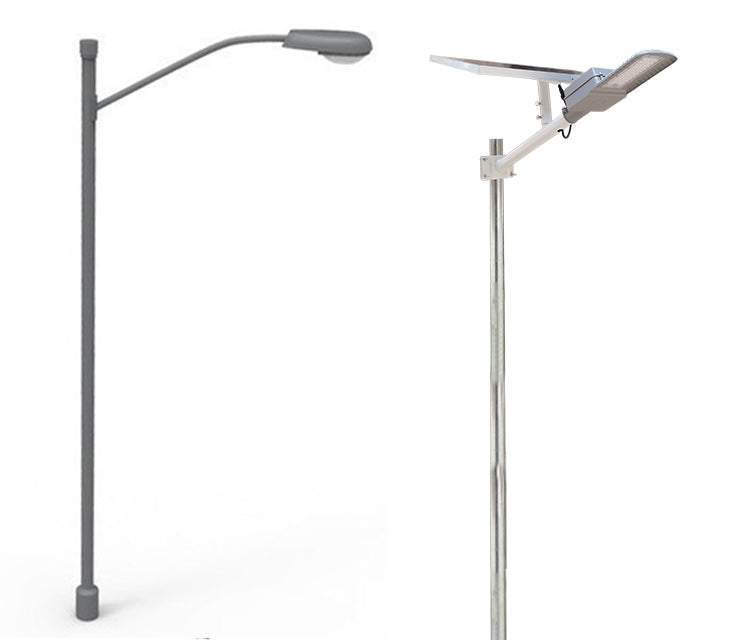
The "solar vs conventional" comparison has shifted in solar's favour over the past decade. Better LiFePO4 batteries, more efficient LEDs, and falling panel prices mean a 2026 solar street light delivers what was a 2-3× cost premium five years ago at near parity with grid-powered fixtures — and beats them outright on total cost of ownership.
Quick comparison
| Property | Solar street lights | Conventional (grid) |
|---|---|---|
| Installation cost | Higher upfront (fixture + battery + panel + pole) | Lower upfront, but cabling/trenching adds significantly per pole |
| Running cost | None | Monthly electricity tariff (typically ₹6-12/unit commercial) |
| Cabling / trenching | None — each pole is self-contained | Required, often the biggest single cost item |
| Grid dependency | None — works through power cuts | Out when grid is down |
| Maintenance | Panel cleaning + battery swap once in 8-10 years (LiFePO4) | Bulb/driver replacement, recurring electricity bills |
| Carbon footprint | Near-zero operating emissions | Grid mix dependent — still substantially coal-heavy in India |
| Suitability — remote sites | Excellent — no grid connection required | Often impractical due to trenching cost |
| Suitability — dense urban | Good, but limited by available sunlight (tall buildings) | Often the better fit |
The economics in 2026
For a typical 6-8m pole installation, the upfront cost of a solar street light is now roughly comparable to a conventional fixture plus cabling and a meter. Over a 10-year window, however, the solar fixture wins decisively:
- Zero electricity bills — for a 40W fixture running ~10 hours a night, grid-powered consumption is ~150 units/year. At ₹8/unit commercial tariff, that's ₹1,200/pole/year — multiplied across an installation of 20-50 poles, the savings compound quickly.
- No trenching, no cable damage — the largest hidden cost of grid-powered street lights is cable theft and accidental damage during roadworks. Solar fixtures sidestep this entirely.
- No outage exposure — solar fixtures keep working through grid failures, which matters most exactly when light is most needed (storms, cuts, etc.).
Where conventional still makes sense
- Dense urban environments with poor sun access — tall buildings or canopy can prevent reliable solar charging.
- Very high-output applications (large sports grounds, industrial yards at 500W+) where battery sizing becomes impractical.
- Existing grid infrastructure — if cabling is already in place and the meter is functional, retrofitting to solar may not pay back.
Where solar wins clearly
- Internal roads, gated communities, factory compounds, schools, parking lots, parks, religious sites, government buildings.
- Rural and semi-urban roads, village pathways, agricultural areas.
- Any site without existing electrical infrastructure.
- Any installation where ongoing electricity costs or outage risk are concerns.
For most off-grid lighting use cases, solar is now the default choice. Browse the Shinesun solar street light range or talk to our team for a site-specific recommendation.