
All-in-One vs Traditional Solar Street Lights — 2026 Comparison
Shinesun's editorial team writes about solar lighting based on our manufacturing, installation, and field-service experience across India.
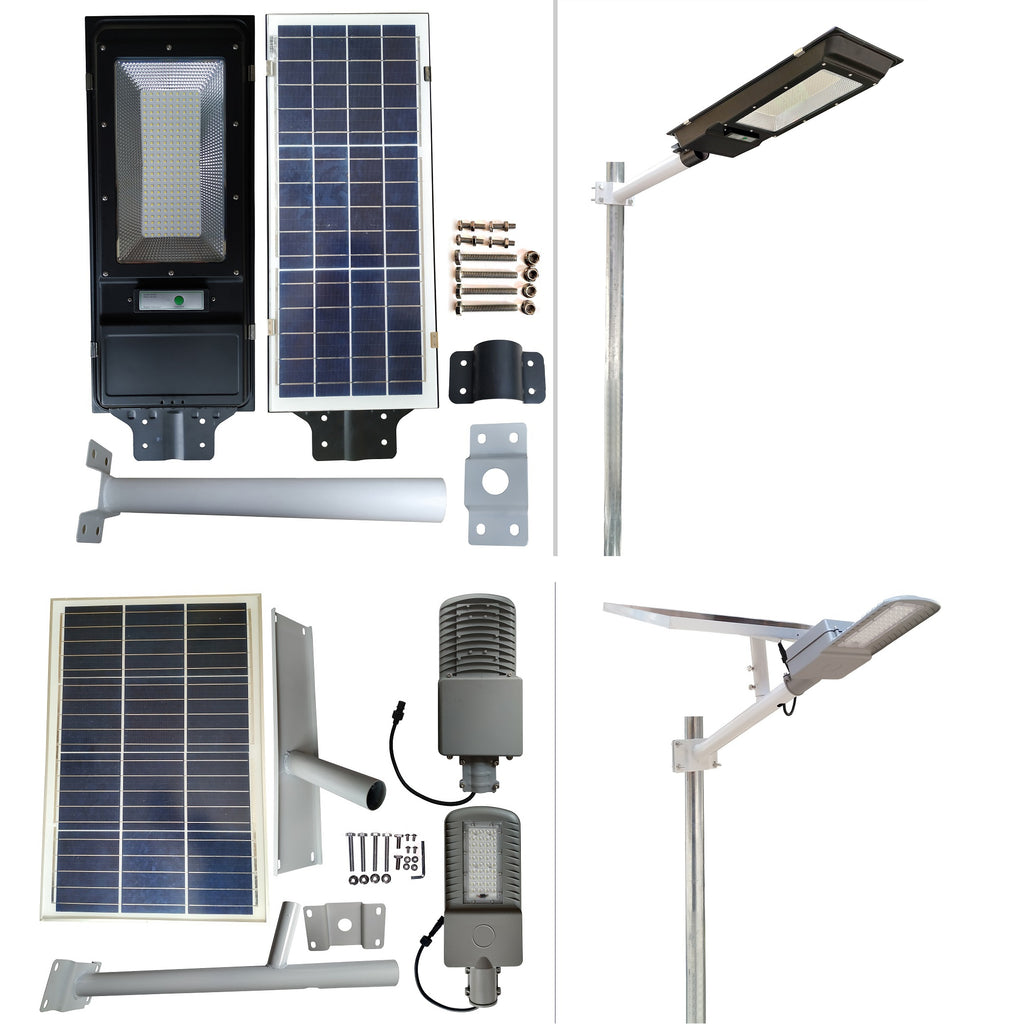
The split-design "traditional" solar street light — separate panel on top, fixture below, battery in a box on the pole — was the standard through the 2010s. All-in-one (integrated) designs, which bundle panel, battery, and LED into a single fixture, have largely taken over by 2026. Here's how the two compare.
What "all-in-one" actually means
An all-in-one solar street light combines the solar panel, battery, charge controller, and LED into a single sealed housing. The whole unit mounts on top of the pole — there's no separate battery box, no inter-component cabling, no panel-to-fixture wiring.
A traditional split design has the panel mounted separately (usually angled at top), the fixture mounted on a crossarm, and a battery box that bolts to the pole or sits at its base.
Quick comparison
| Property | All-in-One | Traditional split |
|---|---|---|
| Installation time | Fast — mount and go | Slower — separate components, more wiring |
| Theft resistance | High — single sealed unit at pole top | Lower — battery box accessible at ground level |
| Wiring vulnerability | None visible | External cables can be cut or damaged |
| Panel angle | Fixed (usually 15-30°) | Adjustable |
| Aesthetic | Clean, modern | More visible hardware |
| Maintenance access | Requires pole climb for any service | Battery accessible from ground |
| Best for | Residential, gardens, gates, small commercial | High-output, large area, customisable installations |
Why all-in-one has become the default
- Installation cost — fewer labour hours per pole, no cable runs, no battery box mounting. The upfront fixture cost is offset by lower install cost.
- Theft and damage — battery boxes at ground level were the single biggest vulnerability of traditional designs. Animals, vandalism, theft of lead-acid batteries for scrap value were all real recurring costs. Integrated designs essentially eliminate this.
- Reliability — fewer external connections means fewer failure points. The internal weatherproofing in modern all-in-one fixtures is generally tighter than what a field-assembled split system achieves.
- Aesthetic — the clean look of a single fixture matters for residential, commercial, and hospitality installations.
When traditional split designs still win
- Very high wattage installations — 200W+ fixtures where battery and panel sizing makes integration impractical.
- Sites needing adjustable panel angle — some equatorial and high-latitude installations benefit from seasonal angle adjustment.
- Customisable component selection — when you need a specific panel chemistry, battery capacity, or LED that's not available in any off-the-shelf integrated design.
- Battery serviceability — sites where ground-level battery access matters more than theft risk (gated/secured premises).
Shinesun's lineup
The Bat, Owl, Nightingale, and Nightjars series are integrated designs covering the most common residential, commercial, and road-lighting use cases. The Hawk series is purpose-built all-in-one for plug-and-play installations. For a starting recommendation, the Solar Bat 40W covers most residential and small-commercial sites. For larger or more specific requirements, talk to our team.