
MPPT vs. PWM Charge Controllers: What Powers the Best Solar Street Lights?
Shinesun's editorial team writes about solar lighting based on our manufacturing, installation, and field-service experience across India.
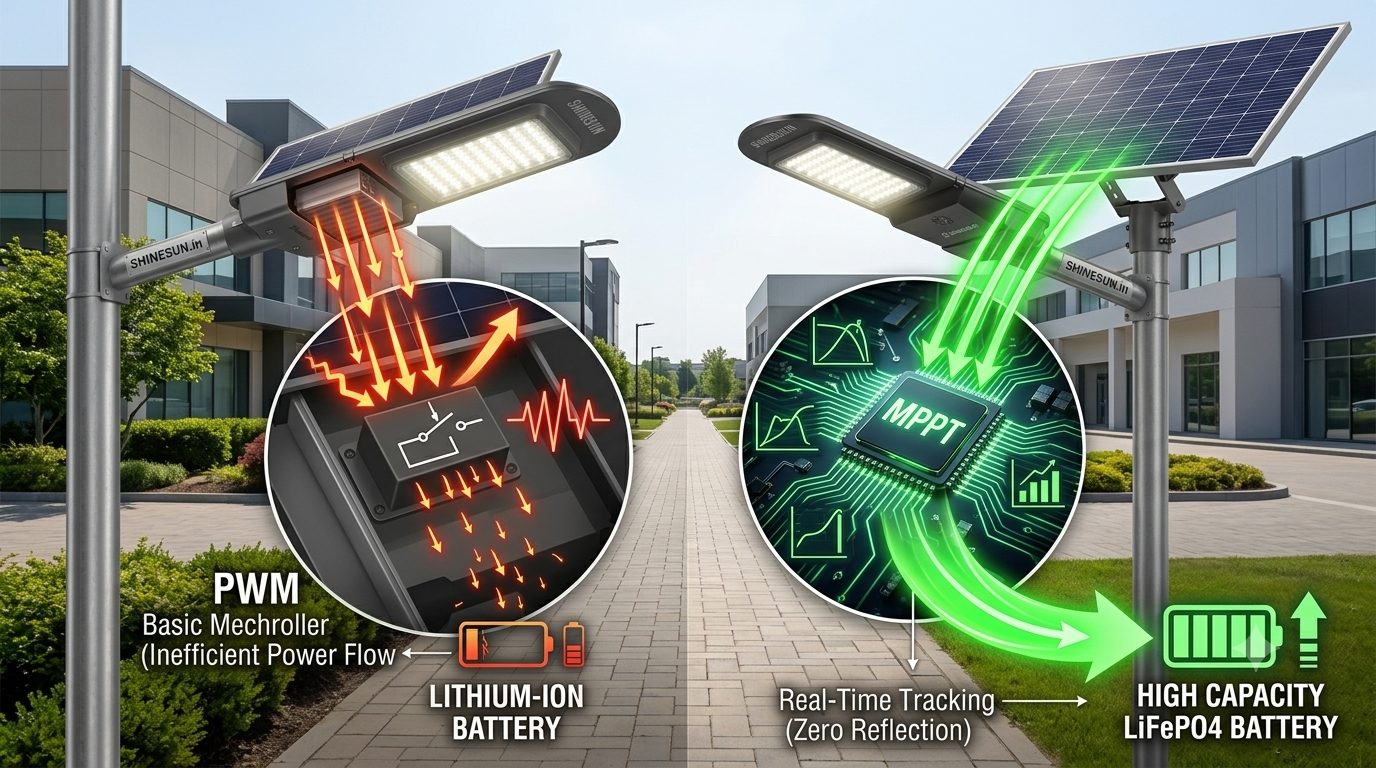
The Brain Behind the Battery
When buying a solar street light, most people focus on the battery size or the LED brightness. However, there is a hidden component that dictates how well the entire system performs. That component is the solar charge controller.
Think of the charge controller as the brain of the street light. It regulates the power moving from the solar panel into the battery. It prevents overcharging during the day and stops the battery from draining completely at night.
Currently, there are two main types of charge controllers used in the industry: PWM (Pulse Width Modulation) and MPPT (Maximum Power Point Tracking). Choosing the wrong one can drastically reduce your light's performance.
What is a PWM Charge Controller?
PWM stands for Pulse Width Modulation. It is the older, more basic technology.
A PWM controller acts like a simple switch. It connects the solar panel directly to the battery. To prevent the battery from overcharging, it rapidly opens and closes the connection.
The major flaw with PWM technology is inefficiency. It forces the solar panel to operate at the same voltage as the battery. If you have a high-voltage solar panel and a low-voltage battery, a massive amount of solar energy is simply wasted. In ideal conditions, PWM controllers are only about 70% efficient. During cloudy weather, that efficiency drops even further.
What is an MPPT Charge Controller?
MPPT stands for Maximum Power Point Tracking. This is the modern, commercial-grade standard for solar lighting.
Unlike a simple switch, an MPPT controller is a smart DC-to-DC converter. It constantly tracks the maximum power output of the solar panel. It then automatically converts that high-voltage power into the exact lower voltage required to charge the battery perfectly.
This tracking process means absolutely no energy is wasted. MPPT controllers boast an efficiency rate of up to 99%.
Why MPPT is Essential for the Indian Climate
Upgrading to MPPT technology is not just a luxury. It is a necessity for reliable off-grid lighting, especially in regions with unpredictable weather.
1. Monsoon Reliability During heavy monsoon months, direct sunlight is scarce. Solar panels produce much lower voltage under heavy cloud cover. A simple PWM controller struggles to push this low power into the battery. An MPPT controller, however, efficiently harvests every drop of available energy. This ensures your street lights still turn on even after three days of rain.
2. Faster Charging Times Because an MPPT controller pulls up to 30% more power from the panel, the battery charges significantly faster. Your lights reach full capacity quickly during short winter days.
3. Maximizing LiFePO4 Batteries High-end solar street lights use advanced Lithium Iron Phosphate (LiFePO4) batteries. These batteries require precise charging profiles to maintain their 10-year lifespan. MPPT controllers provide exactly the right electrical current to keep these premium batteries healthy.
The Shinesun Standard
At Shinesun, we do not compromise on core components. Using cheap PWM controllers leads to dim lights and dead batteries. That is why our premium all-in-one and semi-integrated solar street lights feature advanced MPPT charge controllers.
By pairing high-efficiency monocrystalline panels with smart MPPT tracking, we guarantee brilliant illumination 365 days a year. Explore the Shinesun catalog today to see commercial solar lighting built the right way.