
How Many Volt Battery is Used for a Solar Street Light
Shinesun's editorial team writes about solar lighting based on our manufacturing, installation, and field-service experience across India.
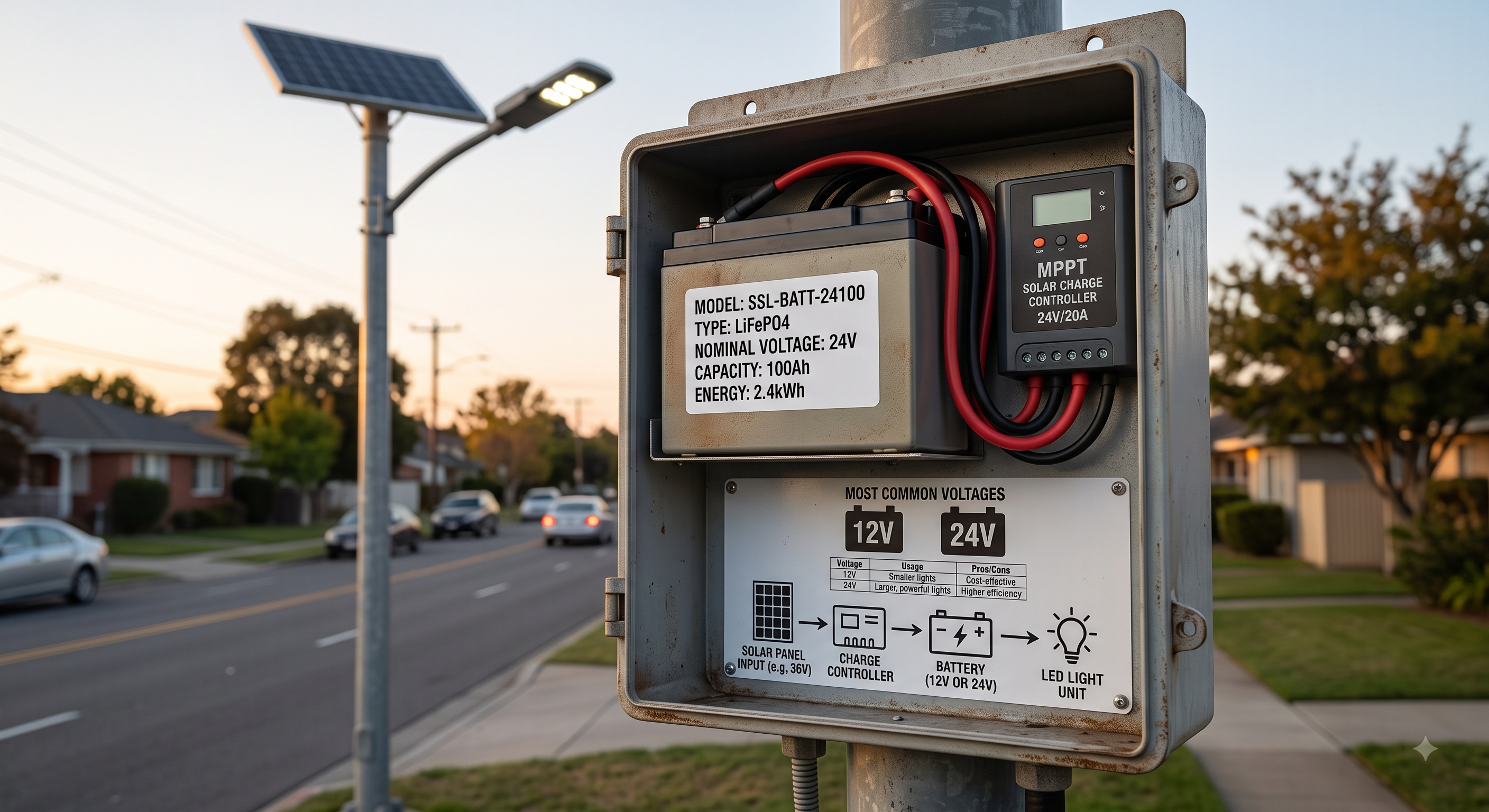
When investing in an off-grid lighting solution, one of the most technical and critical questions buyers have is, "How many volt battery used for solar street light?" Understanding the battery voltage is not just a minor specification; it is the beating heart of your entire lighting system. The voltage determines how brightly your lights will shine, how long they will last during the night, and whether they will survive a stretch of cloudy days.
The Shift from Legacy to Modern Battery Technology To understand modern voltage standards, we first have to look at how solar lighting has evolved. In the early days of off-grid solar technology, the industry heavily relied on bulky 12V or 24V lead-acid batteries. While these traditional batteries were capable of powering older, inefficient bulbs, they came with significant drawbacks. They were incredibly heavy, required regular maintenance, and had a relatively short lifespan before they needed to be replaced.
The transition to modern LED technology changed the landscape entirely. Because LEDs require a fraction of the power to produce the same amount of lumens, massive 12V lead-acid batteries became unnecessary for standard street applications.
The New Standard: 3.2V and 12V Lithium Technology Today, the vast majority of modern all-in-one and semi-integrated solar street lights utilize high-efficiency Lithium Iron Phosphate (LiFePO4) or Lithium-ion battery packs. The standard voltages you will encounter most frequently are 3.2V and 12.8V (often referred to simply as 12V).
The 3.2V LiFePO4 Advantage: For compact, all-in-one solar street lights designed for residential pathways, gardens, or smaller commercial roads, a 3.2V LiFePO4 battery is incredibly common. The lower voltage pairs perfectly with high-efficiency LED chips. Because the required voltage is low, the solar panel does not have to work as hard to push a charge into the battery. This means the system can charge effectively even on overcast or rainy days, ensuring reliable performance year-round. These batteries offer excellent thermal stability, a high cycle life (often between 3,000 to 5,000 cycles), and are incredibly safe.
The 12V (12.8V) High-Power Systems: For heavy-duty commercial applications—such as illuminating major highways, massive parking lots, or industrial estates—manufacturers often step up to a 12V or 12.8V LiFePO4 battery system. These higher-voltage setups are designed to power high-wattage LED arrays (like 60W, 100W, or 120W fixtures). While they require a larger solar panel to charge efficiently, they provide the robust power necessary to cast wide pools of light across expansive areas.
Intelligent Voltage and Smart Motion Sensors The most impressive feature of these modern battery voltages is how they integrate with intelligent controllers and motion sensors. To maximize the lifespan of a 3.2V or 12V battery, modern solar street lights rarely burn at 100% capacity all night.
Instead, the built-in controller smartly manages the voltage draw. During the late night hours when no motion is detected, the controller drops the voltage sent to the LEDs, dimming the light to a lower percentage (such as 20% or 30%). This conserves massive amounts of stored energy. The moment a pedestrian or vehicle enters the sensor's range, the controller instantly safely draws more power to boost the LED back to 100% brightness. This smart management is exactly how a modern solar street light can easily last from dusk until dawn on a compact battery pack.
Choosing the Right Voltage for Your Needs When determining the right solar street light for your project, do not automatically assume that a higher voltage is always better. A well-engineered 3.2V system with a high-quality solar panel and efficient LEDs will easily outperform a poorly designed 12V system. Focus on the total battery capacity (measured in Amp-hours or Ah) combined with the voltage to understand the true power storage of the unit. Whether you choose a 3.2V model for your driveway or a 12V powerhouse for a commercial facility, modern lithium battery technology ensures you are getting the most reliable off-grid lighting available today.