
Technical Guidelines for Solar Street Light Projects (2026)
Shinesun's editorial team writes about solar lighting based on our manufacturing, installation, and field-service experience across India.
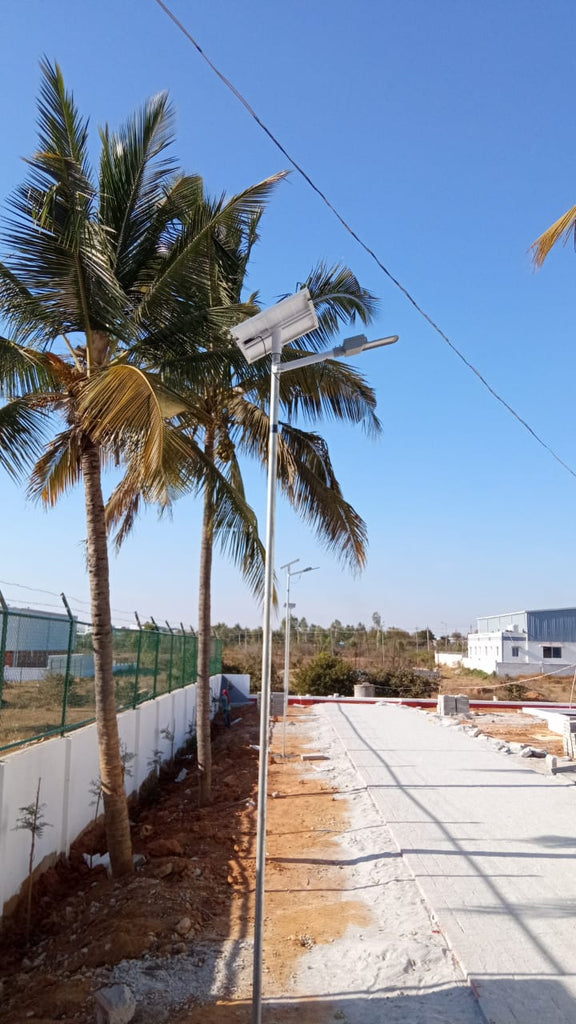
Solar street light projects need clear technical guidelines to deliver good outcomes — particularly at commercial and institutional scale, where specifications, procurement, and installation involve multiple stakeholders. This is a 2026 practical guideline framework covering the key technical decisions for solar street light projects.
Project scoping and site survey
Site survey checklist
- Total area to be lit and number of poles required
- Pole heights appropriate to lit area and use case
- Sun exposure at each pole position (verified at 10am, noon, 3pm)
- Future shading (planned construction, tree growth)
- Soil conditions for foundation design (rocky, alluvial, sandy)
- Wind exposure for pole structural design
- Existing infrastructure (buried services, drainage)
- Access for installation (vehicle, lifting equipment)
- Service access for ongoing maintenance
- Lightning exposure (tall poles, open sites)
Output specification
Based on the use case, specify minimum lux at ground level:
- Pathways — 5-10 lux average
- Residential streets — 5-15 lux average
- Society / society internal roads — 10-20 lux average
- Main commercial roads — 15-30 lux average
- Industrial / parking — 20-50 lux
- Security-sensitive — 30-100 lux on demand
Fixture specification
Required specs for any commercial fixture
- LED wattage and rated lumens at that wattage (with measurement standard)
- LED chip manufacturer (Bridgelux, Lumileds, Osram preferred)
- Lumens per watt (system efficacy) ≥130 lm/W
- Colour temperature (typically 4000-5500K for streets)
- CRI ≥70 (≥80 for residential)
- Solar panel — monocrystalline, sized at 2-3× LED wattage, rated efficiency ≥20%
- Battery — LiFePO4, sized for 2-3 day autonomy minimum
- Charge controller — MPPT above 30W, with battery protection
- Sensor — PIR or microwave motion sensor with disclosed range
- Housing — IP66 die-cast aluminium with powder coating
- Surge protection — Class II/III SPD integrated
- Mounting bracket — adjustable, stainless steel hardware
- Documented warranty per component
Pole specification
- Material — galvanised steel (hot-dip preferred); octagonal common
- Height — matched to fixture wattage and lit area
- Wall thickness — 3-5mm typical, more for taller poles
- Base plate — with anchor bolt pattern matched to foundation
- Internal earthing provision — for surge protection connection
Foundation specification
- Concrete grade — M20 minimum, M25 for taller poles
- Dimensions — 0.6×0.6×0.8m typical for 4-6m poles; larger for taller
- Rebar — for poles 6m+
- Anchor bolts — cast in with proper exposure for pole base attachment
- Cure time — 14 days before pole loading
Earthing specification
- Earth electrode — copper rod (≥2m, ≥16mm) or copper plate
- Earth resistance — ≤10Ω (≤5Ω for commercial)
- Connection — to pole base and fixture surge protection
- Equipotential bonding — for multi-pole installations
Procurement guidelines
Vendor evaluation criteria
- Real manufacturing or assembly presence (verifiable)
- BIS / IEC certifications
- Component-level documentation
- Reference installations (verifiable)
- Service network coverage for project region
- Documented warranty terms
- Financial stability for long-warranty support
Tender / RFP best practices
- Specify required components, not just nominal wattage
- Include performance acceptance criteria (lumens, autonomy days, sensor function)
- Require sample testing before bulk acceptance
- Include installation and commissioning SLAs
- Specify warranty terms (panel, battery, electronics) with penalty clauses
- Include post-installation service requirements
Quality control during procurement
- Pre-shipment inspection (random sample testing)
- Receiving inspection at site
- Sample environmental testing for IP rating
- First-fixture installation as commissioning model
- Documented traceability for warranty claims
ALMM compliance (effective 1 June 2026)
From 1 June 2026, MNRE's ALMM List-II (Approved List of Models and Manufacturers — solar cells) becomes mandatory for government, PSU, and CPSU-funded solar projects, in addition to the long-standing List-I requirement for modules. Any solar street light project tendered through a government or government-affiliated entity from this date must source modules built with cells on List-II.
What this means in practice for street light projects:
- Verify ALMM listings — module manufacturer must appear on List-I; cell source on List-II
- Documentation — vendor should provide ALMM certificate references in the tender response
- Effective date — applies to procurement orders placed on or after 1 June 2026
- Private commercial projects — not strictly required, but increasingly used as a quality and supply-chain-traceability signal
For private commercial or institutional buyers, ALMM compliance isn't mandatory — but manufacturers willing to procure ALMM-listed components have typically established better component traceability than those who can't.
Installation guidelines
Pre-installation
- Confirm foundation design with site geotechnical data
- Mark all positions, verify final sun exposure
- Plan installation sequence and lifting requirements
- Verify earth electrode availability and resistance
During installation
- Foundation execution per spec (concrete grade, dimensions, cure time)
- Pole installation with verified verticality and torque-tightened anchor bolts
- Fixture mounting with adjustable bracket aimed correctly
- Earth connection from fixture through pole to electrode
- Cable entries sealed with appropriate glands
- Sensor and panel sight lines clear
Commissioning
- Dusk operation verified
- Motion sensor triggered and behavior confirmed
- LED output measured (lumens, lux at ground)
- Earth resistance measured and documented
- All commissioning data documented per fixture for traceability
Post-installation
Operating procedures
- Panel cleaning schedule (quarterly minimum, monthly in dusty regions)
- Quarterly visual inspections
- Annual structural and earth resistance check
- Battery replacement planned at year 8-10
Service documentation
- As-built drawings with pole positions and fixture serial numbers
- Warranty cards / documentation per fixture
- Service contact information for warranty claims
- Spare parts inventory recommendation
Project economics
Sample 50-pole commercial installation cost breakdown (2026)
- Fixtures (50 × 60W quality): ₹750,000-1,250,000
- Poles (50 × 8m galvanised): ₹500,000-750,000
- Foundations (50 × M25 with rebar): ₹250,000-500,000
- Earthing systems: ₹100,000-200,000
- Installation labour: ₹300,000-500,000
- Project management: ₹100,000-200,000
- Contingency: 5-10%
Total estimated: ₹2.0-3.5 million for a 50-pole quality commercial installation. Grid-tied equivalent would typically run higher when cabling and DISCOM coordination are included.
10-year TCO comparison
Solar: install + one battery refresh ≈ ₹2.2-3.7 million
Grid: install + 10 years electricity at commercial tariff ≈ ₹2.5-4.5 million (plus DISCOM coordination friction)
The gap widens for larger installations, sites where cabling cost is high, and locations with frequent grid outages.
Common project failure modes to avoid
- Lowest-bid procurement — quality matters more than upfront cost for 8-10 year fixtures
- Inadequate site survey — fixtures installed in shaded or unsuitable positions
- Foundation undersizing — poles lean within first monsoon
- Skipped earthing — fixtures damaged at first thunderstorm
- No post-install service plan — fixtures gradually fail without intervention
- Vendor without service network — warranty claims impossible to action
Shinesun's project support
Shinesun supports commercial and institutional solar street light projects with site survey, fixture specification, installation guidance, and post-installation service across India. For project enquiries (typically 20+ fixtures), contact the team with project details.