
Solar Street Lights for the Desert and Arid Regions (2026)
Shinesun's editorial team writes about solar lighting based on our manufacturing, installation, and field-service experience across India.
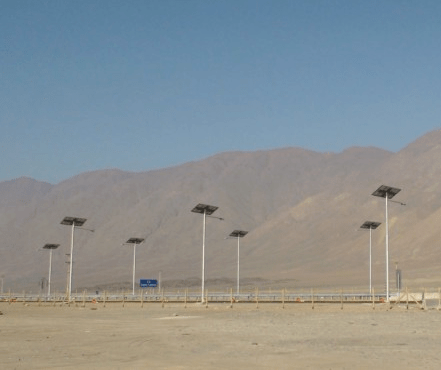
Desert and arid environments — Rajasthan, parts of Gujarat, Kutch, Ladakh, the Thar — have very different solar street light requirements than humid coastal or monsoon-heavy regions. The good news: extreme sun means solar panels overproduce. The challenge: heat, dust, and sand abrasion are hard on fixtures. Here's the 2026 view of what to specify for desert solar street lighting.
What's different about desert conditions
- Very high peak sun hours — 6-8+ hours/day vs 4-5 in humid regions
- Extreme ambient temperatures — 45-50°C+ in summer; can exceed 60°C on panel surfaces
- Heavy diurnal swings — 25-30°C swing between day and night common
- Dust and sand — fine dust accumulates fast on panels; sand abrasion damages lenses and seals
- Low humidity — easier on electronics than coastal, but UV damage to plastics is accelerated
- Sparse vegetation — little shading; fixture orientation is rarely compromised
- Wind loading — open exposed sites often have strong winds
Where each component spec changes
Solar panel
- Panel sizing — can be slightly smaller (1.5-2× LED wattage) in consistently sunny conditions, but generous sizing still recommended for dust losses
- Anti-reflective coating — essential for high-angle sun
- Tempered glass — sand impact resistance
- Frame sealing — UV-resistant gaskets that don't crack in desert sun
Battery
- LiFePO4 absolutely essential — thermal stability in high heat is non-negotiable
- Li-Ion is poor choice for desert — degrades faster in heat; some thermal-runaway risk
- Lead-acid is the wrong answer — short lifespan compounds with heat damage
- Battery sizing — autonomy can be lower (1-2 days vs 2-3) due to reliable daily charging, but build in safety margin for dust storms
Charge controller and electronics
- Temperature compensation — controller must adjust charging based on battery temperature
- Thermal management — controller heat sinking, enclosure ventilation
- Conformal-coated PCBs — protect against fine dust ingress
LED
- Junction temperature management — LED efficiency drops at high temp; quality fixtures have proper heat sinks
- Branded LED chips — better high-temperature behaviour than no-name
- Wide operating temperature rating — LED driver should be rated to 70°C+ operating temperature
Housing
- Die-cast aluminium — required; ABS plastic UV-degrades fast
- UV-resistant powder coat — desert sun bleaches cheap finishes
- IP66 minimum — dust resistance more critical than water
- Sand-resistant seals — silicone gaskets, not cheap rubber
Sand and dust management
- Cleaning frequency — every 2-4 weeks in dusty regions (vs every 2-3 months elsewhere)
- Self-cleaning panel coatings — some premium panels have hydrophobic / oleophobic coatings; useful in dusty regions
- Avoid horizontal mounting — angled panels shed dust better than near-flat panels
- Sandstorm exposure — extreme events can damage panels; consider replacement coverage in warranty terms
Heat management strategies
- Light-coloured housing — reflects rather than absorbs heat
- Ventilation slots — some quality fixtures include controlled ventilation that doesn't compromise IP rating
- Battery placement — ideally not directly under the sunlit top surface
- LED current derating — driver may reduce LED current at very high temperatures to prevent damage
- Mount on cooler side of pole — for split designs, place battery on shaded side
Common desert installation problems
- Panel output drops fast after install — usually dust accumulation; cleaning recovers
- Premature battery failure — usually Li-Ion or lead-acid degrading in heat; LiFePO4 is the answer
- Plastic housing cracking — UV damage; switch to aluminium fixtures
- Sensor false-triggers — high ambient heat reduces PIR contrast; consider microwave sensors
- Bracket corrosion in dust storms — fine grit erodes paint and exposes metal; use coated stainless hardware
Maintenance schedule for desert installations
- Every 2-4 weeks — panel cleaning (more frequent than typical schedules)
- Quarterly — visual inspection, check housing seals, hardware tightness
- Semi-annual — check battery condition (where accessible), check LED output
- Annual — full structural inspection, earth resistance measurement, replace any UV-damaged components
What to specify for desert installations
- Monocrystalline panel with anti-reflective coating, tempered glass
- LiFePO4 battery (non-negotiable)
- MPPT controller with temperature compensation
- Branded LED chips with driver rated to 70°C+ operating
- Die-cast aluminium housing, light-coloured powder coat
- IP66 with silicone gaskets
- UV-resistant external materials throughout
- Documented heat-rated warranty (some suppliers de-rate warranty in hot climates — verify before buying)
Bonus: solar in arid regions actually outperforms
Despite the harsh conditions, arid Indian regions are some of the best solar generation environments in the country. With proper fixtures designed for the heat and dust, solar street lights typically operate at higher overall output than identical fixtures in cloudier humid regions. The maintenance is more frequent; the generation is correspondingly higher.
Shinesun's desert-rated fixtures
Shinesun supplies solar street lights for projects across Rajasthan, Gujarat, and other arid Indian regions, with LiFePO4 batteries, die-cast aluminium housings, and heat-rated electronics as standard on the commercial range. For desert installation specs, contact the team.